

The Short Answer

The Short Answer
If you read nothing else, read this. Each truck wins real things here, and a handful of the things buyers expect to separate them turn out to be level.
In Central Indiana this is the truck comparison people actually run, usually in a driveway with a trailer already hitched to something. The straight verdict first: the 2026 Ford F-150 tows more, up to 13,500 lb (pounds) when properly configured against up to 13,300 lb when properly configured for the Silverado 1500, and the F-150 reaches its number on a four-wheel-drive truck while Chevrolet reaches its number on a two-wheel-drive one. Properly configured means built with the exact engine, cab, bed and equipment the rating is based on. The Silverado answers with a lower starting price, about $36,900 against about $39,330 at launch, both excluding destination charge, the fee for getting a new truck from the factory to us, and with a turbo-diesel the 2026 F-150 does not offer at all.
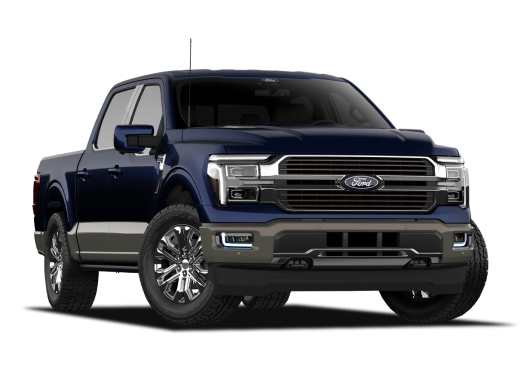
Neither side's wins cancel out the other's, so we have put both trucks' published figures side by side instead of arguing for one side. Every figure below names the configuration behind it, because on a full-size truck the configuration is most of the story. A tow rating with no cab, no bed length, no engine and no drivetrain attached to it is not really a rating, it is a headline. Where the Silverado wins, we say so plainly. Where the two brands are not measuring the same thing, we say that too instead of crowning somebody.
If you read nothing else, read this. Each truck wins real things here, and a handful of the things buyers expect to separate them turn out to be level.
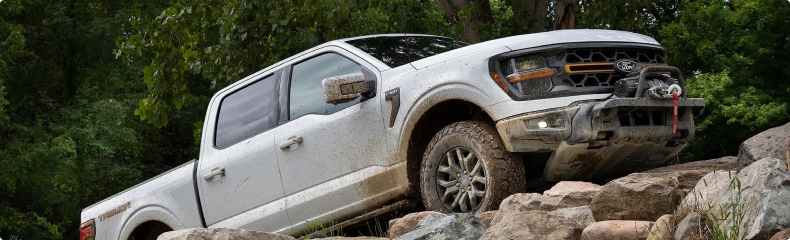
It carries the higher maximum tow rating, up to 13,500 lb when properly configured, and it reaches that as a four-wheel-drive (4x4) truck while the Silverado's maximum comes from a two-wheel-drive one. Four-wheel drive adds hardware and weight, which normally works against a tow rating, so the F-150 earns the bigger number from the more difficult starting point.
Its engine range is the wider of the two, running from a 2.7L (2.7 liter) turbocharged V6 all the way to a 720 hp (horsepower) supercharged V8, the most powerful engine in the F-150 lineup. Six engines share one 10-speed automatic transmission, so moving up or down the range changes the engine without changing the transmission underneath it.
Its EPA-estimated gas fuel economy is the better of the two at each end of the range, the 2.7L turbocharged V6 and the 5.0L V8. It offers a full hybrid, the 3.5L PowerBoost, that the Silverado 1500 lineup does not include, and that hybrid makes more torque than every F-150 engine except the off-road Raptor R, while still being rated to tow. It offers BlueCruise hands-free highway driving. And it holds a 5-star overall federal crash rating in every rated 2026 configuration, across all 3 cabs and both drivetrains, including the four-door, four-wheel-drive version that a family truck tends to be. We set those ratings out cab by cab further down.

It is the cheaper truck to get into, at about $36,900 against about $39,330 at launch, both with destination fees excluded. That is roughly $2,400 at the entry point, and on a work fleet or a first truck that is real money, not a rounding error.
It offers the 3.0L Duramax turbo-diesel, which makes 495 lb-ft (pound-feet) of torque and leads every engine compared on this page on EPA-estimated fuel economy, and the 2026 F-150 has no diesel answer to it. In four-wheel drive the F-150's PowerBoost hybrid closes most of that fuel-economy gap, which is the tie set out below. If a diesel is a firm requirement and not just a preference, that one point settles the comparison before you read anything else.
Its top screen is the larger of the two, at 13.4 inches with Google built-in against 12 inches. Its warranty is modestly stronger on paper too. Chevrolet extends powertrain coverage to 5 yr/100,000 mi (5 years or 100,000 miles) behind two of its engines, the 2.7L TurboMax four-cylinder and the 3.0L Duramax turbo-diesel, and it states a 6 yr/72,000 mi safety restraint term, the coverage that applies to seat belts and airbags. Read the powertrain one closely: it follows those two engines, not the whole lineup.
Seating is the same story on both: 3 across in a Regular Cab, up to 6 in the bigger cabs. Bumper-to-bumper coverage, the broad new-vehicle warranty, matches at 3 yr/36,000 mi, and base powertrain coverage, the engine and transmission term, matches at 5 yr/60,000 mi. Both trucks ship a standard driver-assistance suite instead of charging for the basics, Ford Co-Pilot360 on one and Chevy Safety Assist on the other.
And with four-wheel drive under each of them, the F-150's PowerBoost hybrid and the Silverado's Duramax diesel land in effectively the same fuel-economy territory, by two completely different routes. That is the most interesting tie on the page, because the two engines do not feel remotely alike from the driver's seat even though the fuel bill ends up in a similar place.
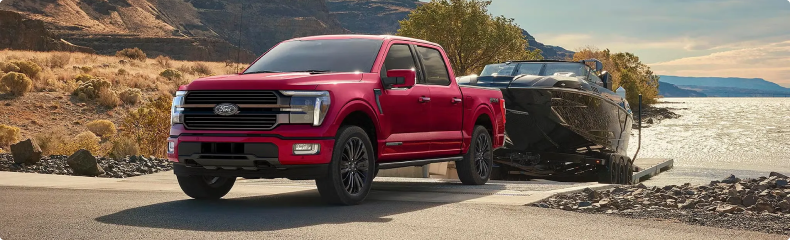
Towing and payload figures in this table are maximums reached only when the truck is properly configured, and each one names its own basis. MSRP means the manufacturer's suggested retail price.
| Spec | 2026 Ford F-150 | 2026 Chevrolet Silverado 1500 |
|---|---|---|
| Cab choices | Regular Cab, SuperCab, SuperCrew | Regular Cab, Double Cab, Crew Cab |
| Seating | 3, or 5 to 6 depending on cab and seat choice | 3 or 6, and 5 on the off-road ZR2 with bucket seats |
| Engines offered | 2.7L EcoBoost V6, 5.0L V8, 3.5L EcoBoost V6, 3.5L PowerBoost full hybrid V6, 3.5L EcoBoost High-Output (Raptor), 5.2L Supercharged V8 (Raptor R) | 2.7L TurboMax four-cylinder, 5.3L V8, 6.2L V8, 3.0L Duramax turbo-diesel |
| Transmission | 10-speed automatic on every engine | 8-speed automatic (2.7L TurboMax); 10-speed automatic (5.3L, 6.2L, Duramax) |
| Peak horsepower | 720 hp (5.2L Supercharged V8, Raptor R) | 420 hp (6.2L V8) |
| Peak torque | 640 lb-ft (5.2L Supercharged V8, Raptor R) | 495 lb-ft (3.0L Duramax turbo-diesel) |
| Maximum towing | Up to 13,500 lb when properly configured (3.5L EcoBoost, 4x4 basis) | Up to 13,300 lb when properly configured (Chevrolet's stated basis: Double Cab Standard Bed 2WD, Duramax, Max Trailering Package, 20-inch wheels) |
| Maximum payload | Up to 2,175 lb when properly configured (3.5L EcoBoost, 4x4 basis) | Up to 2,260 lb when properly configured (Chevrolet's stated basis: Regular Cab Long Bed 2WD, TurboMax) |
| Hybrid available | Yes, 3.5L PowerBoost full hybrid | No hybrid in the Silverado 1500 lineup |
| Diesel available | No diesel for 2026 | Yes, 3.0L Duramax turbo-diesel |
| Largest touchscreen | 12-inch, with a 12-inch digital instrument cluster | 13.4-inch, with Google built-in |
| Infotainment system | SYNC 4 | Chevrolet Infotainment 3, or Infotainment 3 Premium |
| Available premium audio | Bang and Olufsen | Bose |
| Standard driver assistance | Ford Co-Pilot360 | Chevy Safety Assist |
| Off-road versions | Tremor, Raptor and Raptor R | Trail Boss family and ZR2, with a factory 2-inch lift, auto-locking differentials and Multimatic DSSV dampers, which are shock absorbers, on ZR2 |
| Federal crash rating, overall | 5 stars in every rated 2026 configuration | 5 stars in every rated configuration except Crew Cab 4WD, which is 4 stars |
| Warranty, bumper-to-bumper | 3 yr/36,000 mi | 3 yr/36,000 mi |
| Warranty, powertrain | 5 yr/60,000 mi | 5 yr/60,000 mi, extended to 5 yr/100,000 mi with the TurboMax and Duramax engines |
| Starting MSRP, destination excluded | About $39,330 | About $36,900 |

This is the section where the two trucks stop looking like twins. Ford runs 6 engines through one 10-speed automatic, including a full hybrid and two purpose-built off-road engines. Chevrolet runs 4, including the only turbo-diesel in this comparison, and uses an 8-speed automatic behind its entry engine and a 10-speed behind the rest.
| Truck | Engine | Horsepower | Torque | Transmission |
|---|---|---|---|---|
| Ford F-150 | 2.7L EcoBoost V6 | 325 hp | 400 lb-ft | 10-speed automatic |
| Ford F-150 | 5.0L V8 | 400 hp | 410 lb-ft | 10-speed automatic |
| Ford F-150 | 3.5L EcoBoost V6 | 400 hp | 500 lb-ft | 10-speed automatic |
| Ford F-150 | 3.5L PowerBoost full hybrid V6 | 430 hp | 570 lb-ft | 10-speed automatic |
| Ford F-150 | 3.5L EcoBoost High-Output (Raptor) | 450 hp | 510 lb-ft | 10-speed automatic |
| Ford F-150 | 5.2L Supercharged V8 (Raptor R) | 720 hp | 640 lb-ft | 10-speed automatic |
| Chevrolet Silverado 1500 | 2.7L TurboMax four-cylinder | 310 hp | 430 lb-ft | 8-speed automatic |
| Chevrolet Silverado 1500 | 5.3L V8 | 355 hp | 383 lb-ft | 10-speed automatic |
| Chevrolet Silverado 1500 | 6.2L V8 | 420 hp | 460 lb-ft | 10-speed automatic |
| Chevrolet Silverado 1500 | 3.0L Duramax turbo-diesel | 305 hp | 495 lb-ft | 10-speed automatic |
Read down the torque column, because torque is the number you feel when a loaded trailer asks the truck to move. Horsepower decides how fast the truck will eventually go; torque decides how hard it pulls away from the stop sign at the bottom of your driveway with a skid steer behind you.
Chevrolet's entry engine is strong for its size, at 430 lb-ft from a 2.7L four-cylinder, and it out-torques the F-150's 2.7L EcoBoost V6, which makes 400 lb-ft. That is a point for the Silverado at the bottom of the range, and we are not going to talk around it. Move up the range and Ford's 3.5L EcoBoost answers with 500 lb-ft, the PowerBoost hybrid tops both at 570 lb-ft, and the Duramax diesel sits at 495 lb-ft while returning better EPA-estimated fuel economy than any gas engine compared here.
The V8 comparison is closer than the badges suggest. Ford's 5.0L V8 makes 400 hp and 410 lb-ft; Chevrolet's 6.2L V8 makes 420 hp and 460 lb-ft from the larger engine, while its 5.3L V8 sits below both at 355 hp and 383 lb-ft. So if you are comparing V8 against V8, the honest read is that the F-150's 5.0L V8 lands between Chevrolet's two: stronger than the 5.3L, short of the 6.2L. And the top of Ford's range simply has no counterpart: the Raptor R's 5.2L Supercharged V8 makes 720 hp and 640 lb-ft, the highest output in either lineup on this page, with the Raptor's 3.5L EcoBoost High-Output at 450 hp and 510 lb-ft below it.
The transmission story is worth one line of its own. Every 2026 F-150 engine comes with the 10-speed automatic, so the transmission is a constant no matter which engine you choose, and across the range two-wheel drive is standard with four-wheel drive optional. On the Silverado, it depends: the 2.7L TurboMax uses an 8-speed automatic, and the 5.3L V8, the 6.2L V8 and the Duramax use the 10-speed. If you are comparing an entry F-150 against an entry Silverado, that is one more difference sitting behind the two engines.
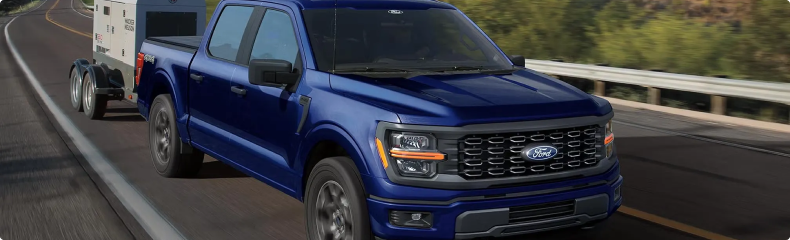
Here is the part that gets quoted wrong more than anything else on a truck page. A maximum tow rating, what the truck can pull behind it, and a maximum payload rating, the weight the truck itself can carry, are not general truck facts. Each one belongs to a single, specific configuration: one engine, one cab, one bed length, one drivetrain, sometimes one wheel size and one towing package. Change any of those and the number changes with it. That is why the table below gives every figure its basis, and why a truck advertised at a big round number may not be rated anywhere near it in the version sitting in front of you.
| Truck and engine | Maximum towing | Maximum payload | Basis |
|---|---|---|---|
| F-150, 3.5L EcoBoost V6 | Up to 13,500 lb when properly configured | Up to 2,175 lb when properly configured | 4x4 |
| F-150, 5.0L V8 | Up to 12,800 lb when properly configured | Up to 2,080 lb when properly configured | 4x4 |
| F-150, 3.5L PowerBoost hybrid | Up to 11,600 lb when properly configured | Up to 1,740 lb when properly configured | 4x4 |
| F-150, 2.7L EcoBoost V6 | Up to 8,200 lb when properly configured | Up to 1,715 lb when properly configured | 4x4 |
| F-150 Raptor | Up to 8,200 lb when properly configured | Up to 1,405 lb when properly configured | 4x4 |
| F-150 Raptor R | Up to 8,700 lb when properly configured | Up to 1,410 lb when properly configured | 4x4 |
| Silverado 1500, maximum towing | Up to 13,300 lb when properly configured | A different configuration, given in the row below | Chevrolet's stated basis: Double Cab Standard Bed 2WD, Duramax, Max Trailering Package, 20-inch wheels |
| Silverado 1500, maximum payload | A different configuration, given in the row above | Up to 2,260 lb when properly configured | Chevrolet's stated basis: Regular Cab Long Bed 2WD, TurboMax |
On towing, the F-150 leads, and the basis makes the lead bigger than the 200 lb gap looks: Ford's 13,500 lb comes from the 3.5L EcoBoost on a four-wheel-drive truck. Four-wheel drive adds hardware and weight, which normally costs a truck some of its tow rating, so it is the harder basis to reach a big number on. Chevrolet's 13,300 lb comes, on Chevrolet's own stated basis, from a Double Cab Standard Bed two-wheel-drive truck with the Duramax, the Max Trailering Package, which is Chevrolet's towing package, and 20-inch wheels. Both are honest published maximums. They are just not reached the same way, and the F-150 reaches its higher number carrying the heavier setup.
On payload, we are not declaring a winner, and here is why: The Silverado's 2,260 lb is higher on paper than the F-150's 2,175 lb. But the Ford figure is a four-wheel-drive figure, and the Chevrolet figure is a Regular Cab Long Bed two-wheel-drive figure with the TurboMax engine, which is about the lightest, most payload-friendly way a full-size truck can be built. Comparing those two numbers directly would be comparing two different trucks and calling it a result. Both numbers are real. Neither one tells you what the truck in your driveway will carry.
Look down the F-150 rows as well as across the two brands, because the spread inside one lineup is wider than the gap between them. The 3.5L EcoBoost is rated up to 13,500 lb when properly configured; the 2.7L EcoBoost, in the same body and on that same four-wheel-drive basis, is rated up to 8,200 lb when properly configured. That is a 5,300 lb difference decided by which engine you choose, and it is the single choice most likely to leave a buyer short of what they needed. The 5.0L V8 sits at up to 12,800 lb and the PowerBoost hybrid at up to 11,600 lb, both when properly configured, so a hybrid is not a step out of serious towing. The two Raptors, at up to 8,200 lb and up to 8,700 lb, are built for a different job entirely, and buying one for maximum trailer weight would be buying the wrong truck for the job.
The practical way to use this table is to start from the trailer, not the truck. Weigh what you pull loaded rather than empty, or look the figure up, then pick the engine whose tow rating clears it with room left over. Then check the other half of it: tongue weight, the downward force a trailer presses onto the hitch, counts against the truck's payload rather than against its tow rating. Working the other direction, picking the truck first and hoping the number covers it, is how people end up towing at the edge of a rating every weekend.
What settles payload for you is the door-jamb sticker on the specific truck you buy. That sticker states that truck's own payload, with its own cab, bed, drivetrain and options already counted. If you are matching a rating to a trailer or a load you already own, that is the number to work from, and our team will read it with you at the truck. You can see which trucks are here now in the 2026 Ford F-150 inventory.
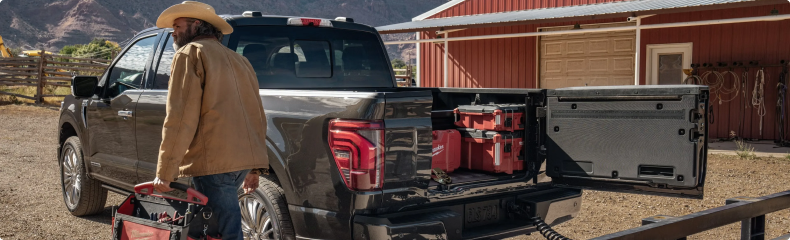
EPA-estimated ratings come from the Environmental Protection Agency's standard test, and they are published per configuration, not per truck. The F-150 figures below are the published 2026 ratings by engine and drivetrain, in miles per gallon.
| Truck and configuration | EPA-estimated miles per gallon, city / highway / combined |
|---|---|
| F-150 3.5L PowerBoost hybrid, 4x4 | 22 / 24 / 23 |
| F-150 2.7L EcoBoost, 2WD | 19 / 25 / 21 |
| F-150 3.5L EcoBoost, 2WD | 17 / 25 / 20 |
| F-150 2.7L EcoBoost, 4WD | 18 / 23 / 20 |
| F-150 5.0L V8, 2WD | 16 / 24 / 19 |
| F-150 5.0L V8, 4WD | 16 / 24 / 19 |
| F-150 3.5L EcoBoost, 4WD | 17 / 23 / 19 |
| Silverado 1500, 3.0L Duramax turbo-diesel | Per-configuration figures are not carried on this page. Best EPA-estimated fuel economy of any engine in this comparison |
Three things fall out of that table. First, the PowerBoost hybrid is the F-150's efficiency answer, and at an EPA-estimated 23 combined in four-wheel drive it is the highest combined rating in the F-150 lineup while also making more torque than every F-150 engine except the Raptor R. It is the rare case where the efficient choice is also the strong one, so it earns a drive before anybody writes it off.
Second, the diesel is the Silverado's efficiency answer, and it is a real one: the Duramax returns the highest EPA-estimated fuel economy of the engines compared here, and Ford has nothing diesel-powered to set against it for 2026. On the F-150 side, the gas story is that the 2.7L EcoBoost in two-wheel drive leads at an EPA-estimated 21 combined, the 5.0L V8 holds an EPA-estimated 19 combined in both two-wheel and four-wheel drive, and the step from two-wheel to four-wheel drive costs each turbocharged V6 a point of combined rating while the V8 rates the same either way.
Third, and this is the honest tie, the diesel's lead narrows to nothing you would plan a week around once both trucks are in four-wheel drive. A 4x4 PowerBoost and a Duramax Silverado land in effectively the same fuel-economy territory, so the decision moves to how they get there.
The hybrid is strongest in stop-and-start town driving, where the electric side does the most work, and it adds torque on top. The diesel is strongest on a long steady highway haul and is the one still pulling hard with a heavy trailer at the back. If most of your miles are town miles with the trailer coming out on weekends, the hybrid's advantage shows up more often; if you tow long distances every week, the diesel's case is stronger. Neither answer is wrong, they just suit different weeks.
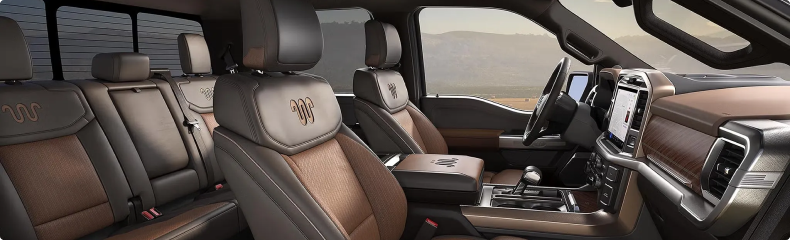
Both trucks give you 3 cabs and a choice of bed lengths, and both seat 3 across on the bench in the smallest cab and up to 6 in the largest. This is the part of the comparison where the two brands sit closest together, so the decision usually comes down to which exact combination each one will build for you.
| Item | 2026 Ford F-150 | 2026 Chevrolet Silverado 1500 |
|---|---|---|
| Cab choices | Regular Cab, SuperCab, SuperCrew | Regular Cab, Double Cab, Crew Cab |
| Seating | 3, or 5 to 6 depending on cab and seat choice | 3 or 6, and 5 on ZR2 with bucket seats |
| Bed offering | Three bed lengths: 5.5 ft, 6.5 ft and 8 ft | The Durabed, Chevrolet's name for the Silverado's bed, with 12 tie-downs rated at 500 lb each |
The two bed descriptions above answer different questions on purpose. Ford rates its beds per bed length and Chevrolet gives one figure covering the Durabed, so we state each side the way its own brand states it rather than forcing the two into a match.
On the F-150 the bed volume is rated per bed length: 52.8 cubic feet with the 5.5 ft bed, 62.3 with the 6.5 ft bed and 77.4 with the 8 ft bed. Chevrolet rates the Durabed at 89.1 cubic feet as a single figure covering the bed. Those two sets of numbers are built differently, Ford's per bed length and Chevrolet's as one figure, so setting them head to head would measure two different things and call the result a fact.
What we can say usefully is how the F-150 side works in practice. You choose your bed volume by choosing your bed length, and each step up is a real jump: nearly 10 cubic feet from the 5.5 ft bed to the 6.5 ft bed, and about 15 more to the 8 ft bed. The 8 ft bed handles full sheets of plywood and long lumber without a fight, and that is the version trades and farm buyers tend to want.
The 5.5 ft bed is the one that fits a normal garage and a normal parking space, and it pairs with the SuperCrew for people whose truck is also the family vehicle. The 6.5 ft bed is the compromise, keeping most of the usefulness without giving up as much room in a garage or a parking space. On the Chevrolet side, the Durabed's 12 tie-downs, each rated at 500 lb, are the detail to note if strapping loads down is a daily part of the job and not an occasional one.
On seating, the practical read is simple. If the truck is a work truck that occasionally carries a passenger, the Regular Cab with its 3-across bench does the job from either brand. If it is the family vehicle that also tows, the SuperCrew and the Crew Cab are the versions to compare, and both get you to 6 seats with a front bench. Where bucket seats are offered they trade that middle front seat for a console, and that is a call to make before you order, not after, because it is the difference between carrying 5 people and carrying 6.
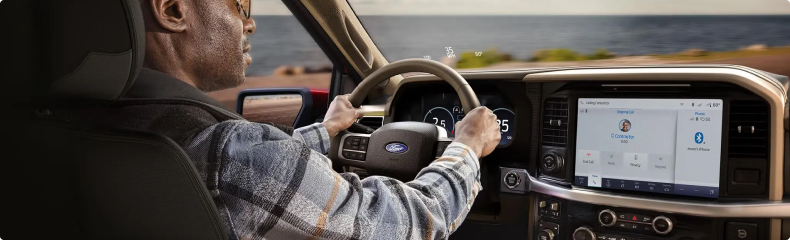
| Feature | 2026 Ford F-150 | 2026 Chevrolet Silverado 1500 |
|---|---|---|
| Infotainment system | SYNC 4 | Chevrolet Infotainment 3, or Infotainment 3 Premium |
| Screens | 12-inch touchscreen with a 12-inch digital instrument cluster | 7-inch touchscreen, or a 13.4-inch touchscreen with Google built-in |
| Available premium audio | Bang and Olufsen | Bose |
| Standard driver assistance | Ford Co-Pilot360 | Chevy Safety Assist |
The Silverado has the bigger screen at its top end, at 13.4 inches against 12, and Google built-in is a real convenience if you already live in that ecosystem. Read the Chevrolet side closely, though: that 13.4-inch screen comes with Infotainment 3 Premium, while Infotainment 3 pairs with a 7-inch screen, so the size advantage belongs to the upper system, not to every Silverado on a lot. The F-150 answers with a matched pair of 12-inch displays, which means the driver gets a full digital instrument cluster as well as the center screen instead of one large screen sitting next to conventional gauges. Which arrangement you prefer is a matter of taste, and 10 minutes in each driver's seat will tell you more than any spec line.
One F-150 feature deserves its own paragraph: BlueCruise. Ford's hands-free highway driving system is available on the 2026 F-150 as a one-time purchase, and it is optional on the XLT with either the 302A or the 303A equipment group, the option packages Ford lists by code, and on Lariat, King Ranch, Platinum and Tremor. If a long stretch of interstate is part of your week, that is a feature you understand by sitting in the truck, not by reading about it, so we will set up a test drive that puts you on the highway instead of a loop around the block.
Both trucks make their driver-assistance suite standard, and that deserves saying plainly: neither one asks you to move up to a pricier version to get the basics. Ford Co-Pilot360 and Chevy Safety Assist are the two names to look for, and on both trucks they are included rather than sold as extras.

Federal crash ratings come from the National Highway Traffic Safety Administration (NHTSA), and they are rated per cab and per drivetrain, which means rear-wheel drive and four-wheel drive are rated separately. The overall star rating combines the front, side and rollover results for that one specific configuration, which is why a brand can hold 5 stars in one cab and 4 in another. Pooling them into one score for a truck would hide exactly the differences a buyer needs to see, so here they are as rated.
That last line matters for a lot of Central Indiana buyers, because that Crew Cab 4WD configuration is exactly what a family truck tends to be: four doors for car seats and passengers, four-wheel drive for the months when the county roads are bad. If you are shopping the four-door, four-wheel-drive version of each truck, the F-150 SuperCrew 4WD holds a 5-star overall rating where the Silverado Crew Cab 4WD holds 4. Compare the configurations that match the truck you intend to buy, not the best result either brand can point to, and be careful with any advertisement that quotes a star rating without naming the cab and drivetrain behind it.

| Coverage | 2026 Ford F-150 | 2026 Chevrolet Silverado 1500 |
|---|---|---|
| Bumper-to-bumper | 3 yr/36,000 mi | 3 yr/36,000 mi |
| Powertrain | 5 yr/60,000 mi | 5 yr/60,000 mi, extended to 5 yr/100,000 mi with the TurboMax and Duramax engines |
Beyond those two shared terms, each brand lists coverage of its own. Because the extra terms do not line up against each other, they sit below the table instead of inside it. The 2026 F-150 carries 5 yr/unlimited miles of corrosion perforation coverage, which is rust-through coverage, and 5 yr/60,000 mi of roadside assistance. The 2026 Silverado 1500 carries a 6 yr/72,000 mi safety restraint term.
On the terms both brands state, the two trucks start level: 3 yr/36,000 mi bumper-to-bumper and 5 yr/60,000 mi powertrain. Chevrolet then extends powertrain coverage to 5 yr/100,000 mi behind two specific engines, the TurboMax and the Duramax, and Chevrolet also states a 6 yr/72,000 mi safety restraint term. That is a modest but real edge on paper, and the engine the longer powertrain term is tied to counts for more than the bigger number does: choose a 5.3L or a 6.2L Silverado and the powertrain term is the same 5 yr/60,000 mi the Ford carries.
That unlimited-mileage corrosion perforation term on the F-150 is the one that matters most here, where salted winter roads work on a truck's body every year no matter how many miles it covers. A mileage cap on corrosion coverage is a cap a low-mileage truck never gets near and a high-mileage truck runs past early, and neither one describes the way rust happens in Indiana. Five years with no mileage limit is a term written the way the problem behaves.

All prices below are launch MSRPs with destination charge excluded, and they are approximate starting figures for each trim, the equipment levels a truck is sold in, not the price of a specific truck. What you pay depends on the configuration, the offers running that month and what is on the lot.
| Truck and trim | Approximate starting MSRP at launch, destination excluded |
|---|---|
| Ford F-150 XL | About $39,330 |
| Ford F-150 STX | About $41,855 |
| Ford F-150 XLT | About $44,695 |
| Ford F-150 Lariat | About $59,560 |
| Ford F-150 Tremor | About $64,915 |
| Ford F-150 King Ranch | About $65,825 |
| Ford F-150 Platinum | About $68,800 |
| Ford F-150 Raptor | About $79,005 |
| Chevrolet Silverado 1500 Work Truck (WT), range starting point | About $36,900 |
| Chevrolet Silverado 1500 ZR2, top of the range | About $71,800 |
The Silverado gets in cheaper. Its Work Truck opened at about $36,900 and the F-150 XL opened at about $39,330, both at launch and both excluding destination, a gap of roughly $2,400 at the entry point. That is real money, and we will name it instead of explaining it away.
Higher up, the ranges tell a different story. The F-150 spreads across 8 priced trims at launch, and the range is worth walking through. XL at about $39,330 is the work truck. STX at about $41,855 and XLT at about $44,695 are the steps most shoppers land on, and XLT is also the first step where BlueCruise becomes optional, on the 302A and 303A equipment groups.
Lariat at about $59,560 is the step into a leather-lined truck, with King Ranch at about $65,825 and Platinum at about $68,800 above it. Tremor at about $64,915 and Raptor at about $79,005 are the off-road versions among these eight launch prices, all figures at launch and destination excluded. The Raptor R, the 720 hp version, sits above them in the lineup.
That spread is the practical point: there is an F-150 configured for a landscaping crew and an F-150 configured as a towing family vehicle with a leather interior, and they are the same truck underneath. It also means the entry-price gap counts for less the further up either range you shop, because by then you are comparing equipment lists, not opening numbers.
A few things move the real number more than the sticker does. Current factory and dealer offers change month to month, and they live on our new Ford specials page. If you or a family member qualifies through an employer or a partner company, X-Plan pricing changes the math before any negotiation starts. You can also get a real figure for what you are driving now with our value my trade tool, and start the paperwork with an online finance application before you come in, which shortens the part of the visit nobody enjoys.
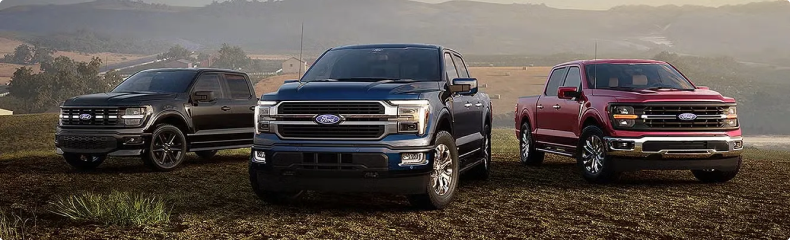
Specs decide arguments; the work decides purchases. Find the line below that sounds like your week.
You tow at or near the limit: The F-150 with the 3.5L EcoBoost carries the strongest tow rating on this page, up to 13,500 lb when properly configured, and it earns it as a four-wheel-drive truck. If your trailer is heavy and your driveway is not flat, that combination is the one to look at first. Check the 5.0L V8 as well, at up to 12,800 lb when properly configured, if you would rather have a V8 without a turbocharger under the hood.
You tow long distances every week: This is the Silverado Duramax's real argument. A turbo-diesel making 495 lb-ft with EPA-estimated fuel economy no other engine in this comparison matches is the better long-haul tool, and the 2026 F-150 has no diesel to counter it. We will tell you that straight. If a diesel is a nice-to-have and not a must, the F-150's 3.5L EcoBoost still carries the higher tow rating of the two trucks.
You drive far more miles than you tow: The PowerBoost hybrid is the F-150 answer, at an EPA-estimated 22 city / 24 highway / 23 combined in four-wheel drive while making 570 lb-ft, and it is still rated to pull up to 11,600 lb when properly configured. It is the version that saves fuel in town without giving up truck capability, and for a commuter who tows a boat or a small trailer on weekends it is usually the right call.
You want the lowest entry price of the two: The Silverado Work Truck opens lower, at about $36,900 at launch. The F-150 XL opens at about $39,330 at launch, and the STX sits just above it at about $41,855. Compare the two entry trucks on the equipment you actually need, not on the opening number alone, because a truck that opens lower and then needs options added is not always the cheaper truck once it is parked in your driveway.
You are buying the family four-door that also works: Compare SuperCrew 4WD against Crew Cab 4WD, and put the federal crash ratings next to each other in that exact configuration, where the F-150 SuperCrew 4WD is rated 5 stars overall and the Silverado Crew Cab 4WD holds 4. Then compare seating, because both trucks reach 6 seats with a front bench, while bucket seats bring the F-150 down to 5 and the Silverado offers 5 on the ZR2 with buckets.
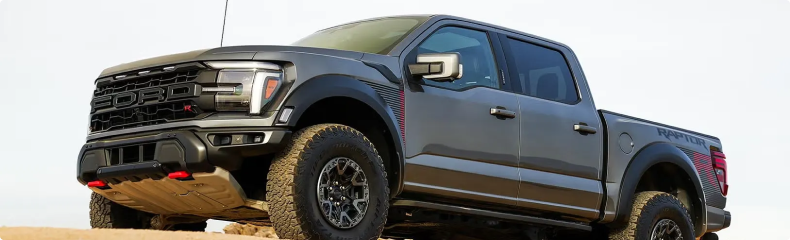
You want the extreme version: The Silverado's off-road end runs the Trail Boss family and the ZR2, with a factory 2-inch lift, auto-locking differentials and Multimatic DSSV dampers on the ZR2. Ford's runs the Tremor, the Raptor and the Raptor R, whose 720 hp supercharged V8 is the most powerful engine in either lineup on this page. These two go about the job in completely different ways, and a drive tells you more than a spec sheet does. Note that both Raptors trade tow rating for off-road ability, at up to 8,200 lb and up to 8,700 lb when properly configured.
Choose the F-150 if: the headline tow rating matters, you want a hybrid, you want hands-free highway driving, you want 5 stars overall from NHTSA in the four-door 4x4 you actually intend to buy, or you want a range that runs from a plain work truck to a 720 hp supercharged V8.
Choose the Silverado 1500 if: you want the lowest opening price of the two, you want a turbo-diesel, you want the largest screen in this comparison, or the engine-linked 5 yr/100,000 mi powertrain term and the 6 yr/72,000 mi restraint term are what you weigh coverage on.
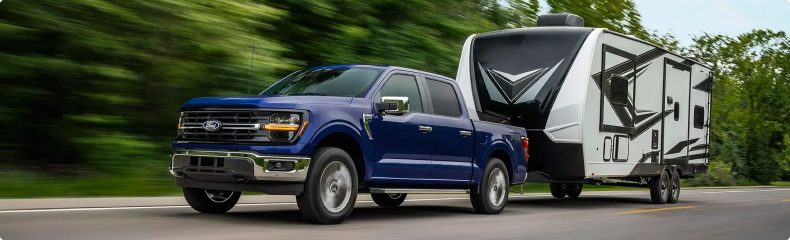
Around Central Indiana a truck is working equipment rather than a style choice. Contractors and trades working out of Anderson, Pendleton and Elwood have a trailer behind the truck most mornings, and the load is real: a skid steer, a mower deck, a dump trailer, a run of lumber. Out in the Madison County townships the ground is corn and soybean, and the truck that works there is bought on value and expected to keep working for a long time. That is a buyer who reads a payload figure carefully and asks which configuration produced it, which is exactly why this page states every basis instead of quoting round numbers. If you are one of them, the engine-by-engine towing table above is the part of this page written for you.
The commute shapes the decision too. I-69 between Anderson and Indianapolis is a daily run for a lot of people here, and that is the stretch where a hands-free highway system stops being a spec-sheet line and turns into an actual difference in how tired you are at the end of the week. It is also the stretch where the difference between a hybrid's city rating and a diesel's highway strength shows up in your fuel spend instead of in a brochure. A truck that spends its mornings crawling through town and its evenings at highway speed is being asked two different questions, and the hybrid answers one of them better while the diesel answers the other.
Then there is the weather. Indiana winters mean salted roads for months, and a lot of the driving around here happens on county gravel that turns to slop in the spring. That is why four-wheel drive is the default expectation on a truck around here and not an upgrade, and it is worth remembering what that costs on paper: the ratings that look best in a brochure are often two-wheel-drive ratings, while the truck people here take home is the four-wheel-drive one. It is also why corrosion coverage deserves a read before you sign. The F-150's corrosion perforation coverage runs 5 years with unlimited miles, which is the kind of term that matters more in the fifth winter than in the first.
Anderson has its own reason why this particular comparison is a live one. This was a General Motors town for generations, with the Delco Remy and Guide Lamp plants employing much of the city, and that history is still in the family stories and in the driveways. In the decades since those plants closed, the city has rebuilt around other work.
What that means for a truck page is straightforward: a lot of people here know GM products extremely well, they have opinions built over decades of ownership, and they walk into our showroom already able to compare. That is a good customer to have and a bad one to oversell. So this page gives you the comparison and not the sales pitch. The Silverado's wins are stated here as plainly as the F-150's, and we would rather point you at the Duramax than lose your trust arguing against it.
Ed Martin Ford is the only Ford dealership in Madison County, and we stock the F-150 across cabs, trims and drivetrains instead of one narrow configuration, so you can drive the engine and the cab you are considering here without a long trip first. If the exact build you want is not on our lot, you can build your F-150 to order and get the engine, cab, bed length and equipment group you want instead of the closest compromise sitting here today. On a truck you plan to keep and work for a decade, waiting a few weeks for the right engine and the right bed length is usually the better trade.
The spec sheets get you close. Sitting in both trucks and pulling something with one settles it. Start the Ford half of that here. Browse the 2026 Ford F-150 inventory or search the full new Ford F-150 selection to see which engines and cabs are here now, then book a test drive and bring the questions your work raises: what this specific truck's door-jamb payload says, how the 10-speed behaves with weight behind it, whether the hybrid or the 3.5L EcoBoost matches your week. Bring the trailer if that is the honest test.
Before you come in, check current new Ford specials, get a number on your current vehicle with value my trade, and, if it applies to you, see whether X-Plan pricing changes your figure. You can also get the paperwork moving ahead of the visit with an online finance application. Want the build that is not on the lot? Start a custom factory order. If the page did not answer your question, contact our team.
Which tows more, the 2026 Ford F-150 or the 2026 Chevy Silverado 1500?
The F-150, and by a wider practical margin than the raw numbers show. The F-150 with the 3.5L EcoBoost V6 is rated up to 13,500 lb when properly configured as a four-wheel-drive truck. The Silverado 1500 is rated up to 13,300 lb when properly configured, on Chevrolet's stated basis of a Double Cab Standard Bed 2WD truck with the Duramax, the Max Trailering Package and 20-inch wheels. Ford's number is both higher and set on the four-wheel-drive configuration, which normally costs a truck some capability.
Other F-150 engines sit lower: up to 12,800 lb with the 5.0L V8, up to 11,600 lb with the PowerBoost hybrid and up to 8,200 lb with the 2.7L EcoBoost, all when properly configured. The engine you choose moves the rating more than the badge on the tailgate does. You can see which engines are here in the 2026 Ford F-150 inventory.
Which one has more payload?
We are not calling a winner on payload, because the two published maximums are not measured the same way. The F-150's maximum is up to 2,175 lb when properly configured with the 3.5L EcoBoost in four-wheel drive. The Silverado's maximum is up to 2,260 lb when properly configured, on Chevrolet's stated basis of a Regular Cab Long Bed 2WD truck with the TurboMax engine, which is a lighter configuration than the Ford figure is drawn from. Both numbers are real; they describe different trucks. The figure that governs what you can carry is on the door-jamb sticker of the specific truck you buy, and we are happy to read it with you.
Does the 2026 Ford F-150 offer a diesel?
No. There is no diesel engine in the 2026 F-150 lineup. The F-150's efficiency engine for 2026 is the 3.5L PowerBoost full hybrid, rated by the EPA at an estimated 22 city / 24 highway / 23 combined in four-wheel drive while producing 430 hp and 570 lb-ft, and still rated to tow up to 11,600 lb when properly configured. If you need a diesel, the Silverado's 3.0L Duramax is a real advantage there, and we will say so.
Does the 2026 Chevy Silverado 1500 offer a hybrid?
No. There is no hybrid in the Silverado 1500 lineup for 2026. The F-150 offers the 3.5L PowerBoost full hybrid, which makes 430 hp and 570 lb-ft, is EPA-estimated at 22 city / 24 highway / 23 combined in four-wheel drive, and is still rated to tow up to 11,600 lb when properly configured. If you want a full-size truck that saves fuel in town without giving up towing, that is the one to drive. Book a test drive and take it through stop-and-start traffic, which is where the hybrid does its best work.
Which truck is cheaper to start?
The Silverado. Its Work Truck opened at about $36,900 and the F-150 XL opened at about $39,330, both launch MSRPs excluding destination charge, a difference of roughly $2,400. Which truck costs more depends on where in the range you shop, though: the F-150 offers 8 priced trims at launch, the highest of those launch prices being the Raptor at about $79,005, while the Silverado launch range runs up to the ZR2 at about $71,800. Current offers move the real number, and ours are on our new Ford specials page.
Which truck is safer in federal crash testing?
Compare the configuration you would sign for, because these ratings are set per cab and per drivetrain. The 2026 F-150 earns 5 stars overall in every rated configuration: Regular Cab, SuperCab and SuperCrew, rear-wheel drive and four-wheel drive, plus the SuperCrew hybrid in four-wheel drive. The 2026 Silverado 1500 earns 5 stars overall in every rear-drive cab and in the Extended Cab 4WD and Regular Cab 4WD configurations as NHTSA lists them, while its Crew Cab 4WD is rated 4 stars overall. So in the popular four-door four-wheel-drive setup, the Ford holds the higher overall rating.
Which gets better fuel economy?
It depends on the engine, and both trucks win a piece of it. Among gas engines the F-150 is the more efficient truck at each end of its range, at an EPA-estimated 19 city / 25 highway / 21 combined for the 2.7L EcoBoost in two-wheel drive and 16 city / 24 highway / 19 combined for the 5.0L V8 in either drivetrain. The Silverado's 3.0L Duramax turbo-diesel is the EPA-estimated fuel-economy leader among the engines compared on this page. In four-wheel drive, the F-150 PowerBoost hybrid at an EPA-estimated 23 combined and the Duramax Silverado end up close to each other by different routes, the hybrid stronger in town and the diesel stronger on a long highway pull.
Which has the better technology inside?
They split it. The Silverado has the larger top screen, at 13.4 inches with Google built-in, against the F-150's 12-inch touchscreen, though that Chevrolet screen comes with Infotainment 3 Premium while Infotainment 3 pairs with a 7-inch screen, and the F-150 pairs its screen with a 12-inch digital instrument cluster in place of conventional gauges. The F-150 runs SYNC 4 with available Bang and Olufsen audio and standard Ford Co-Pilot360; the Silverado runs Chevrolet Infotainment 3 or Infotainment 3 Premium with available Bose audio and standard Chevy Safety Assist. The clearest F-150 advantage is BlueCruise hands-free highway driving, available as a one-time purchase and optional on the XLT with either the 302A or the 303A equipment group, plus Lariat, King Ranch, Platinum and Tremor.
Which warranty is better?
The Silverado's is modestly stronger on paper. Both trucks carry 3 yr/36,000 mi bumper-to-bumper coverage and 5 yr/60,000 mi powertrain coverage. Chevrolet extends powertrain coverage to 5 yr/100,000 mi behind the TurboMax and Duramax engines specifically, so a 5.3L or 6.2L Silverado carries the same 5 yr/60,000 mi term the Ford does, and Chevrolet states a 6 yr/72,000 mi safety restraint term on top of that. The F-150 carries 5 yr/unlimited miles of corrosion perforation coverage and 5 yr/60,000 mi of roadside assistance, and that unlimited-mileage corrosion term earns real attention on salted Indiana winter roads.
Can I order an F-150 built exactly the way I want it?
Yes. If we do not have the exact combination on the lot, the engine, cab, bed length, drivetrain and equipment group together, a custom factory order builds that truck instead of asking you to settle for the nearest available one. It takes longer than driving something home the same week, and for a truck you intend to keep and work for years it is usually the better trade. Browse what is here now in the new Ford F-150 selection first, since the configuration you want may already be in stock.