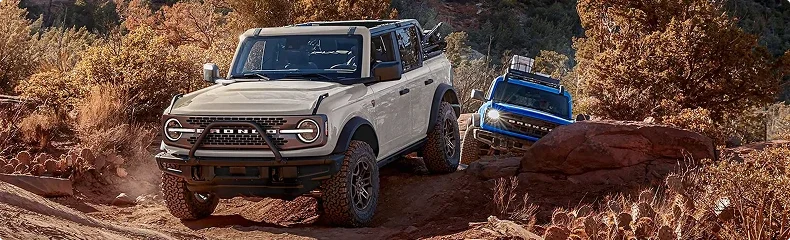
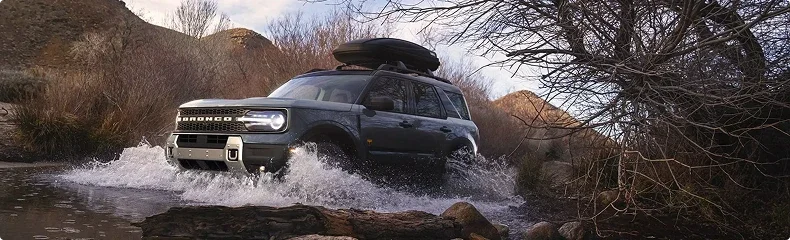
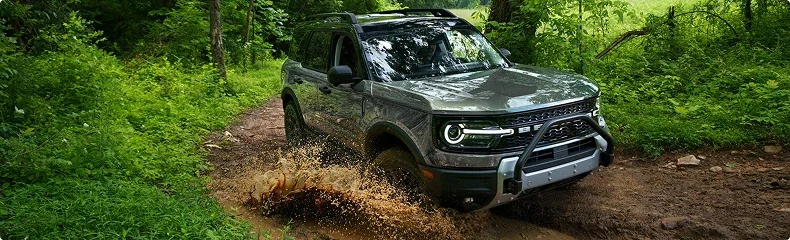
How the 2026 Bronco and Wrangler Compare

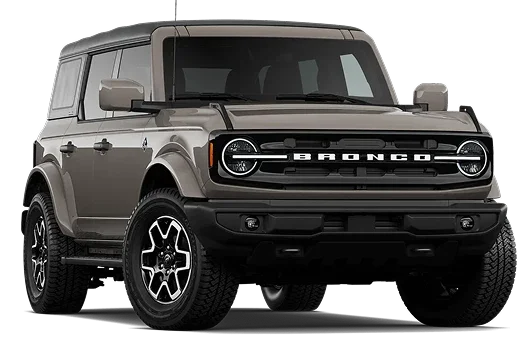
Both are body-on-frame 4x4s, meaning the body sits on a separate truck frame, both have doors and a roof that come off, both are sold as a 2-door or a 4-door, and around Anderson people compare them constantly. Here is the straight read before the tables.

How the 2026 Bronco and Wrangler Compare

Jump To

Jump To
  • Where the Bronco Wins
  • Where the Wrangler Wins
  • Where They Tie
  • At a Glance
  • Power & Performance
  • Off-Road & Towing
  • Interior & Cargo
  • Price & Trims
  • Which Is Right for You
  • Central Indiana
  • FAQ

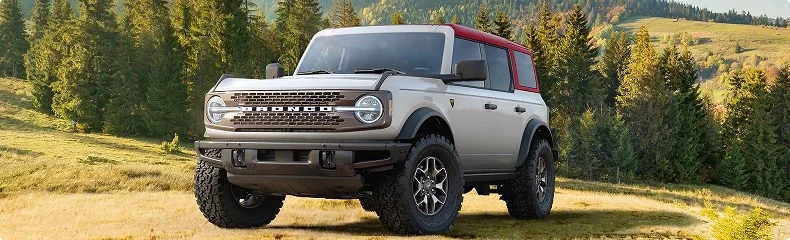
Short version: the Bronco's 2.7L EcoBoost V6 makes more power than the Wrangler's 3.6L Pentastar V6, the Bronco holds more gear in both body styles, and its cabin pairs a phone without a cable, while the Wrangler costs less to get into and can still be ordered with a V8.

  • Bronco strengths: its 2.7L EcoBoost V6 makes a lot more torque than the Wrangler's 3.6L Pentastar V6, both body styles hold more cargo, and the dash pairs a phone wirelessly, with Ford Co-Pilot360 driver assistance standard.
  • Wrangler strengths: it costs less to get into, at launch $36,035 against $40,795 for the Bronco, destination charge excluded on both, and the 6.4L V8 has no Ford answer in this matchup.

A lot of what shoppers expect to separate these two is actually a tie: the 4-door tow rating, the warranties, and the off-road numbers at the top of each range.

When two vehicles are built this close to the same idea, details decide it, not one big argument. So the rest of this page sets both spec sheets side by side and names the trim or the package behind a figure wherever the spec sheets name one. A trim is the named version of the vehicle you order.

Where the Bronco Wins

Where the Bronco Wins

Where the Bronco Wins

Power is the clearest gap. The Bronco's 2.7L EcoBoost V6 carries 150 lb-ft (pound-feet) more torque than the Wrangler's 3.6L Pentastar V6, and torque is what you feel pulling a loaded trailer up a highway on-ramp or hauling a boat out of the water. The gap holds lower down the range too: the Bronco's 2.3L EcoBoost four makes 300 hp (horsepower) and 325 lb-ft on premium fuel, while the Wrangler's 2.0L turbo four makes 270 hp and 295 lb-ft.

Towing goes the same way in the 2-door. A 2-door Bronco is rated up to 3,500 lb (pounds) once the Class II Trailer Tow Package, the factory towing setup, is on it, against 2,000 lb for a 2-door Wrangler. That is the difference between having a small boat or a loaded utility trailer behind you and leaving it at home.

The Bronco also holds more cargo in each body style, and by the widest margin in the 2-door. Inside, the SYNC media system runs a 12-inch touchscreen that pairs a phone wirelessly, Ford Co-Pilot360 driver assistance is standard, and the Bronco's off-road drive modes and trail-assist features are built into how it drives rather than sold as an add-on. The 2.7L EcoBoost V6 comes with a 10-speed automatic, which matters more on a 45 mph state road than on a trail.

Where the Wrangler Wins

Where the Wrangler Wins

Where the Wrangler Wins

The Wrangler is cheaper to get into. The Sport launched at $36,035, $4,760 under the Base Bronco. That is real money up front, and the price advantage holds one step higher too: Sport S launched at $39,685, still under where the Bronco range opens.

It is also the only side of this matchup available with a V8: the 6.4L V8 in the Moab 392 makes 470 hp and 470 lb-ft, and the most powerful Bronco, the Raptor, tops out at 418 hp and 440 lb-ft from a 3.0L EcoBoost V6. If the engine itself is the reason you are buying, only one of these two answers that.

The Wrangler also sits higher straight from the factory, 10.8 inches of ground clearance against the Base Bronco's 8.3, so the two cheapest versions are nowhere near each other on clearance before a package is added. Its windshield folds flat and the Bronco's does not, and the range of parts made for it by outside companies, its aftermarket, is the widest in this class, so there is a bolt-on part for nearly every change an owner wants to make. On 35-inch tires it also reaches a 47.4-degree approach angle, which measures the steepest rise a vehicle can nose into before the front bumper touches, and that is the single steepest number either vehicle claims.

Where They Are Effectively Tied

Where They Are Effectively Tied

Where They Are Effectively Tied

Both use part-time four-wheel drive instead of all-wheel drive, so both ask the driver to shift into 4x4 on purpose rather than letting a computer decide. Both seat 4 as a 2-door and 5 as a 4-door, and both take their doors and tops off. Both 4-doors tow up to 3,500 lb, which means a family buying the long version for trailer duty gets the same rating either way.

Compare the upper trims and they land close on the numbers that get quoted most: roughly 10.5 to 13 inches of ground clearance and roughly 33 to 34 inches of water fording, which is the depth of standing water each one is rated to cross, with the Raptor above both at up to 37 inches. Both carry a 3 year/36,000 mile basic warranty and a 5 year/60,000 mile powertrain warranty, and neither carries a federal crash-test rating for 2026, so there is no star score to compare in either direction. Both also top out near $80,000 at launch, at $79,995 for the Bronco Raptor and the same $79,995 for the Moab 392.

At a Glance: 2026 Bronco vs. Wrangler

At a Glance: 2026 Bronco vs. Wrangler

At a Glance: 2026 Bronco vs. Wrangler

Prices in this table are the manufacturer's suggested retail price, or MSRP, at launch. Towing, clearance, fording and approach-angle figures are maximums, and where a specific trim or package is what reaches the figure, the table below names it.

Spec 2026 Ford Bronco 2026 Jeep Wrangler
Body styles 2-door and 4-door 2-door and 4-door
Seating 4 (2-door) or 5 (4-door) 4 (2-door) or 5 (4-door)
Drive system Part-time 4x4, body-on-frame Part-time 4x4, body-on-frame
Engines offered 2.3L turbo four-cylinder, 2.7L turbo V6, 3.0L turbo V6 (Raptor) 2.0L turbo four-cylinder, 3.6L V6, 6.4L V8
Transmissions 7-speed manual (2.3L) or 10-speed automatic 8-speed automatic (2.0L and 6.4L); 6-speed manual (3.6L)
Peak horsepower 418 hp (Raptor, 3.0L, premium fuel) 470 hp (6.4L V8, premium fuel)
Peak torque 440 lb-ft (Raptor, 3.0L, premium fuel) 470 lb-ft (6.4L V8)
Maximum towing Up to 3,500 lb (2.3L and 2.7L, Class II Trailer Tow Package); up to 4,500 lb (4-door Raptor) Up to 3,500 lb (4-door); up to 2,000 lb (2-door)
Maximum ground clearance Up to 13.1 in (Raptor) Up to 12.9 in (with 35-inch tires)
Maximum approach angle Up to 47.2 degrees (Raptor); 43.3 degrees with the Sasquatch Package Up to 47.4 degrees (with 35-inch tires)
Maximum water fording Up to 33.5 in; up to 37 in (Raptor) Up to 34 in
Cargo behind the second row, cubic feet 20.6 (2-door), 35.6 (4-door) 12.9 (2-door), 31.7 (4-door)
Cargo behind the first row, cubic feet 52.0 (2-door), 77.6 (4-door) 31.7 (2-door), 72.4 (4-door)
Touchscreen and media system SYNC, 12-inch Uconnect 5, 12.3-inch
Smartphone integration Wireless Apple CarPlay and Android Auto Apple CarPlay and Android Auto
Premium audio available Bang and Olufsen Alpine
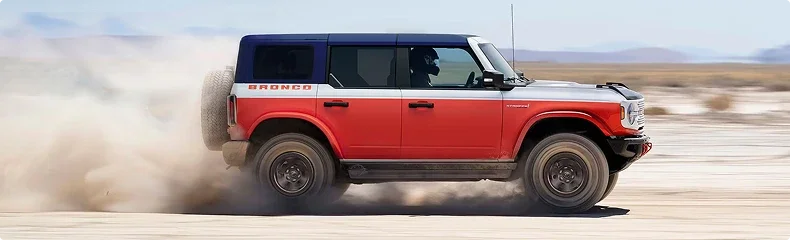
Open-air features Removable doors and roof, hardtop or soft top Removable doors and top, fold-down windshield
Trim levels 9, Base through Raptor 7, Sport through Moab 392
Starting MSRP $40,795 $36,035
Basic warranty 3 years / 36,000 miles 3 years / 36,000 miles
Powertrain warranty 5 years / 60,000 miles 5 years / 60,000 miles
Federal crash-test rating Not rated Not rated

Power and Performance

Power and Performance

Power and Performance

Six engines are spread across these two ranges, and the honest comparison depends on which pair you line up. EcoBoost and Pentastar are the two brands' names for their engine families rather than features you add.

Engine Vehicle Horsepower Torque Transmission
2.3L EcoBoost turbo four-cylinder Ford Bronco 300 hp on premium fuel (275 hp on regular) 325 lb-ft 7-speed manual or 10-speed automatic
2.7L EcoBoost turbo V6 Ford Bronco 330 hp on premium 410 lb-ft 10-speed automatic
3.0L EcoBoost turbo V6 (Raptor) Ford Bronco 418 hp on premium 440 lb-ft 10-speed automatic
2.0L turbo four-cylinder Jeep Wrangler 270 hp 295 lb-ft 8-speed automatic
3.6L Pentastar V6 Jeep Wrangler 285 hp 260 lb-ft 6-speed manual
6.4L V8 Jeep Wrangler 470 hp 470 lb-ft 8-speed automatic

Compare the engines like for like and the Bronco is ahead on power everywhere except the top of the Wrangler range. At the entry point the Bronco's 2.3L four-cylinder holds a 30 hp and 30 lb-ft edge over the Wrangler's 2.0L. Move up a step and the 2.7L EcoBoost V6 delivers 330 hp and 410 lb-ft while the 3.6L Pentastar delivers 285 hp and 260 lb-ft. Torque is the number that matters in a heavy 4x4, and 410 against 260 is not a close call.

A detail worth knowing before you shop the entry engines: the Bronco's 2.3L is rated at 300 hp on premium fuel and 275 hp on regular, so the headline figure carries a fuel bill with it. The 2.7L and the Raptor's 3.0L are both quoted on premium as well. The Wrangler's 3.6L V6 and 2.0L four carry a single rating each, and the 6.4L V8 is a premium-fuel engine.

Transmission choice separates them as much as engine size does. Both EcoBoost V6 engines in the Bronco come with a 10-speed automatic, and the 2.3L can be ordered with either a 7-speed manual or that same 10-speed. On the Wrangler side, the 2.0L turbo and the 6.4L V8 run an 8-speed automatic, and the 3.6L Pentastar is the manual engine, paired with a 6-speed. So the two ranges answer the same question in opposite ways: the Bronco puts its manual behind the smallest engine and its most gears behind the V6, while the Wrangler reserves its manual for the V6 and automates everything else.

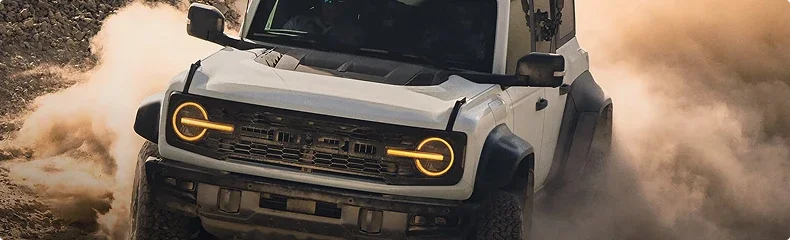
The top of the ladder flips the whole comparison. The 6.4L V8 in the Moab 392 puts out 470 hp and 470 lb-ft, and the Bronco Raptor's 3.0L EcoBoost V6 answers with 418 hp and 440 lb-ft. The Raptor is quick, but it is not a V8, and no amount of turbocharging changes what some buyers want to hear at idle. If a V8 is a requirement and not a preference, that decision is already made.

Off-Road Geometry and Towing

Off-Road Geometry and Towing

Off-Road Geometry and Towing

Off-road capability is the category these two get compared on, and it is closer than the marketing on either side suggests. The table below mixes entry figures with maximums. Where a specific trim or package is what reaches a figure, the cell names it.

Measure 2026 Ford Bronco 2026 Jeep Wrangler
Ground clearance, entry 8.3 in (Base) 10.8 in
Ground clearance, higher trims 10.5 in (Badlands), 11.5 in (Heritage), 11.5 to 11.6 in with the Sasquatch Package and its 35-inch tires Up to 12.9 in with 35-inch tires
Ground clearance, maximum Up to 13.1 in (Raptor) Up to 12.9 in (with 35-inch tires)
Approach angle Up to 47.2 degrees (Raptor); 43.3 degrees with the Sasquatch Package 44 degrees (2-door) and 43.9 degrees (4-door); up to 47.4 degrees with 35-inch tires
Water fording Up to 33.5 in; up to 37 in (Raptor) 31.5 in; up to 34 in
Maximum towing, 2-door Up to 3,500 lb (2.3L and 2.7L, Class II Trailer Tow Package) Up to 2,000 lb
Maximum towing, 4-door Up to 3,500 lb; up to 4,500 lb (4-door Raptor) Up to 3,500 lb
Drive system Part-time 4x4 on every trim, not all-wheel drive Part-time 4x4 on every trim, not all-wheel drive

Neither side wins this table outright. The Wrangler starts higher off the ground, 10.8 inches against the Base Bronco's 8.3, so a shopper comparing the two entry models is looking at a real gap in the Jeep's favor. Equipping the Bronco closes most of that gap but not the one at the top: Badlands at 10.5 inches still sits just under an entry Wrangler, Heritage at 11.5 inches clears it, and 11.5 to 11.6 inches with the Sasquatch Package on 35-inch tires still sits under the up to 12.9 inches a Wrangler reaches on 35-inch tires. The one Bronco that clears the Jeep everywhere is the Raptor, up to 13.1 inches, and the Raptor is a $79,995 vehicle at launch. So on ground clearance the Wrangler is ahead for most of the way up both ranges, and the Ford answer arrives only at the very top.

Read the rest of the rows the same way and the results split rather than favoring one vehicle. Towing goes the Bronco's way in the 2-door, and the two 4-doors match apart from the Bronco Raptor. Clearance goes the Wrangler's way until the Raptor arrives, and approach angle goes the Wrangler's way all the way up. Fording is close through the middle of both ranges. The drive systems are the same on both.

On 35-inch tires the Wrangler reaches a 47.4-degree approach angle, a shade past the Raptor's 47.2 and well past the 43.3 degrees a Sasquatch-equipped Bronco reaches. In standard form the Wrangler sits at 44 degrees as a 2-door and 43.9 as a 4-door. Fording splits the same way at the mainstream end and reverses at the top: up to 34 inches for a Wrangler against up to 33.5 inches for most Broncos, then up to 37 inches for the Raptor.

Towing is where the 2-door buyer should pay attention. A 2-door Bronco fitted with the Class II tow package is rated to pull up to 3,500 lb; a 2-door Wrangler is rated at 2,000 lb. Step up to either 4-door and both are rated up to 3,500 lb, with a 4-door Bronco Raptor rated up to 4,500 lb. If you assumed the 2-door of either one was the towing compromise, that is true of the Wrangler and not of the Bronco.

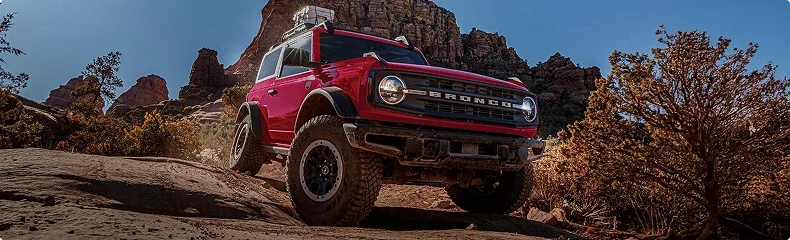
One thing both share is worth saying plainly, because it gets confused constantly in the showroom. Both vehicles use part-time four-wheel drive on every trim, which is a different thing from the all-wheel drive in a crossover. Part-time 4x4 locks the front and rear axles together for low-traction surfaces, which is what makes it stronger than a crossover all-wheel-drive system in mud or deep snow, and it waits for you to engage it instead of running all the time. The Bronco stacks its G.O.A.T. off-road drive modes on top of that hardware, along with Trail Turn Assist and Trail Control, and all of it comes with the vehicle instead of costing extra.

One honest limit on everything above: geometry and tow ratings are only part of an off-road answer. Trim decides the rest of the off-road kit on both vehicles, including locking differentials, a sway bar that disconnects, low-range gearing, and the tires and underbody protection that a given build carries. None of that shows up in a clearance figure. Those are worth putting side by side in person, and we are happy to do that with you here in Anderson, IN.

Interior, Technology and Cargo

Interior, Technology and Cargo

Interior, Technology and Cargo

Neither of these is a quiet luxury SUV, and both are built to be hosed out. Where they part ways is the dash and the cargo hold.

Feature 2026 Ford Bronco 2026 Jeep Wrangler
Touchscreen and media system SYNC with a 12-inch touchscreen Uconnect 5 with a 12.3-inch touchscreen
Smartphone integration Wireless Apple CarPlay and Android Auto Apple CarPlay and Android Auto
Premium audio Bang and Olufsen available Alpine premium audio available
Seating 4 (2-door) or 5 (4-door) 4 (2-door) or 5 (4-door)
Cargo behind the second row 20.6 cu ft (2-door), 35.6 cu ft (4-door) 12.9 cu ft (2-door), 31.7 cu ft (4-door)
Maximum cargo behind the first row 52.0 cu ft (2-door), 77.6 cu ft (4-door) 31.7 cu ft (2-door), 72.4 cu ft (4-door)
Open-air setup Removable doors and roof, hardtop or soft top Removable doors and top, fold-down windshield

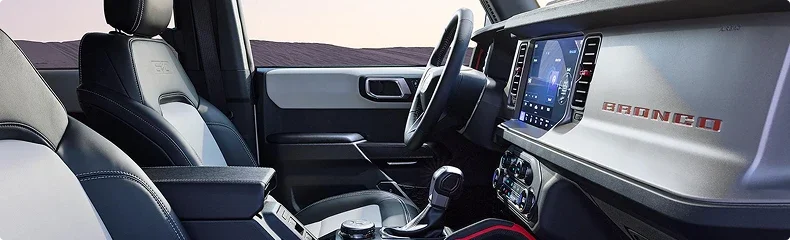
The screens are close in size, 12 inches against 12.3, and both handle iPhone and Android mirroring, so the spec line reads like a tie. The difference is the cable. The Bronco's phone connection is wireless, so it links up as soon as you sit down, which is a small thing once and a noticeable thing on the fifth short trip of a Saturday. Ford Co-Pilot360 comes standard on the Bronco, and Bang and Olufsen audio is available. The Wrangler offers Alpine premium audio, and the base Sport comes with analog dial gauges and an 8-speaker system, which some buyers read as basic and others read as exactly right for a vehicle that gets driven with the doors off.

Cargo is the wider gap, and it is widest in the 2-door. A 2-door Bronco holds 20.6 cubic feet behind the back seat and 52.0 with that seat folded; a 2-door Wrangler holds 12.9 and 31.7. In practice that means a 2-door Bronco with the back seat folded can be loaded for hauling in a way the 2-door Wrangler cannot, and 12.9 cubic feet with the seat up is closer to a large trunk than to a cargo bay.

In the 4-doors the split narrows to 35.6 against 31.7 behind the second row and 77.6 against 72.4 behind the first, so the family versions are far closer than the short ones. For a household that camps, hauls hockey bags, or keeps a dog crate in back, the behind-the-second-row figure is the one to look at twice, because that is the space you have with everyone still in their seats.

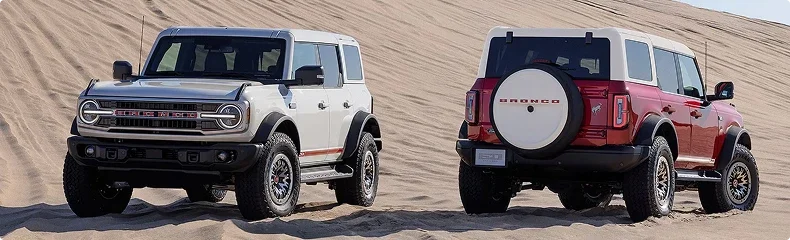
Both vehicles are also open-air by design rather than by option. The Bronco's doors and roof come off, with a hardtop or a soft top depending on how the Bronco is built, and the Wrangler's doors and top come off and its windshield folds flat as well. Anyone planning to store a removed roof or a set of doors through an Indiana winter should think about garage space before they think about spec sheets.

Price and Trims

Price and Trims

Price and Trims

All figures below are MSRP at launch and exclude destination, the mandatory delivery charge on both vehicles.

2026 Ford Bronco trim MSRP at Launch
Base $40,795
Big Bend $41,295
Outer Banks $48,190
Badlands $48,890
Heritage $51,625
Stroppe $69,995
Raptor $79,995

The step from Base to Big Bend is only $500, which makes Big Bend the easy first move up. The bigger price jumps come further along, and they buy hardware: Badlands brings 10.5 inches of ground clearance against the Base Bronco's 8.3, and Heritage takes that to 11.5. Above those sit Stroppe and the 418 hp Raptor, where the prices climb steeply. The full Bronco ladder also includes Black Diamond and Wildtrak between the trims shown here.

2026 Jeep Wrangler trim MSRP at Launch
Sport $36,035
Sport S $39,685
Willys $43,755
Sahara $48,910
Moab 392 $79,995

The step from Sport to Sport S is $3,650, and Willys and Sahara continue the climb from there before the range tops out at the V8-powered Moab 392. The jump from Sahara to Moab 392 is a gap in the table, not a gap in the range: the Rubicon and Rubicon X sit between those two prices, and they are the Wranglers an off-road shopper usually has in mind. Their figures are not shown above, so treat that stretch of the range as one to price out on a specific build rather than to read off this page. Putting a Rubicon build next to the Bronco trim you are weighing is something our team can walk through with you.

Lining the two ladders up by price band is the fastest way to see where a budget actually lands you, since the same money buys a different position in each range.

Price band at launch 2026 Ford Bronco 2026 Jeep Wrangler
Under $40,000 No trim opens below $40,000 Sport $36,035; Sport S $39,685
$40,000 to $45,000 Base $40,795; Big Bend $41,295 Willys $43,755
$45,000 to $55,000 Outer Banks $48,190; Badlands $48,890; Heritage $51,625 Sahara $48,910
Above $55,000 Stroppe $69,995; Raptor $79,995 Moab 392 $79,995

The pattern is clear once it is laid out this way. The Wrangler has the entry end to itself, because the Bronco range does not open until $40,795 at launch. In the $40,000 to $45,000 band the Bronco gives you more trims to choose from.

Then the two converge almost exactly in the high $40,000s, where Badlands at $48,890 and Sahara at $48,910 sit $20 apart at launch. Above that both climb steeply and both finish at $79,995. So the price argument is a real one down at the entry trims and close to even for a shopper spending around $49,000.

Which One Is Right for You

Which One Is Right for You

Which One Is Right for You

Off-road capability is what these two get argued over, and both of them earn the argument. But once you accept that both will handle far more than most owners ask of them, the deciding question narrows to how you want to live with an open-air 4x4 that also has to do the school run.

Choose the Bronco if it has to work as a daily driver first. More torque from the 2.7L V6, a 10-speed automatic behind its V6 engines, wireless smartphone integration, standard Ford Co-Pilot360, and clearly more cargo room in both body styles all point the same direction. If you tow a small trailer with a 2-door, the 3,500 lb rating against 2,000 lb settles it outright.

Choose the Wrangler if the smallest payment up front matters most, or you want a windshield that folds flat, or you want a V8. The Sport is the less expensive entry of the two, Ford has no equivalent of the 6.4L Moab 392 in this matchup, and the widest aftermarket in this class means a Wrangler can be modified further and more cheaply than its rivals.

Here is how the split looks against specific priorities.

What matters most to you Better fit Why (any prices are MSRP at Launch)
Least money up front Wrangler Sport $36,035 against $40,795 for the Base Bronco
Everyday power and pulling strength Bronco 2.7L EcoBoost V6 at 330 hp and 410 lb-ft against 285 hp and 260 lb-ft from the 3.6L Pentastar
Towing with a 2-door Bronco Up to 3,500 lb with the Class II Trailer Tow Package against 2,000 lb
Towing with a 4-door Either Both rated up to 3,500 lb
A V8 Wrangler The 6.4L Moab 392 makes 470 hp and 470 lb-ft; the top Bronco is a 418 hp V6
Hauling gear and dogs Bronco More cargo room in both body styles, and much more in the 2-door
Connecting a phone without a cable Bronco Wireless Apple CarPlay and Android Auto on the Bronco's 12-inch SYNC screen
Clearance without adding a package Wrangler 10.8 inches at entry against 8.3 inches on the Base Bronco
The steepest approach angle Wrangler Up to 47.4 degrees on 35-inch tires, just past the Raptor's 47.2
Deepest rated water crossing Bronco Up to 37 inches on the Raptor against up to 34 inches on a Wrangler
A manual transmission Either Bronco pairs a 7-speed manual with the 2.3L; Wrangler pairs a 6-speed with the 3.6L V6
Heavy modification later Wrangler The widest aftermarket in this class
Doors and roof off Either Both remove their doors and tops

What Matters on Central Indiana Roads and Trails

What Matters on Central Indiana Roads and Trails

What Matters on Central Indiana Roads and Trails

Anderson sits on the flat to gently rolling farm country of the Central Indiana till plain. The 4x4 work around here is gravel county roads through the corn and soybean townships, muddy unpaved lanes after a wet spring, boat ramps, and Indiana winters with snow and road salt. It is not desert rock-crawling, and that changes how you should read the spec sheets above.

A 47-degree approach angle and 37 inches of fording are genuine engineering, and they are the numbers this comparison usually gets argued on. Around here they are also the numbers you are least likely to ever use. What you will actually use is everyday four-wheel-drive confidence on an unplowed road, enough clearance to keep a rutted lane from becoming an expensive afternoon, and how the vehicle drives on the 20-minute run that fills most of the week, down Scatterfield Road or up I-69.

Read the comparison through that lens and the priorities reorder themselves. The clearance number that matters is the one on the trim you can actually afford, not the maximum in the brochure, which is why 10.8 inches on an entry Wrangler and 8.3 on a Base Bronco is a more useful pair of figures than 12.9 against 13.1.

That pair goes to the Wrangler, and it deserves saying plainly rather than skipping past. An entry Wrangler sits 2.5 inches higher than a Base Bronco, it costs less, and on a rutted township lane after a wet spring that height is a difference you would genuinely notice. Of the Bronco trims listed above, the first one that tops it is the Heritage at 11.5 inches. What the Base Bronco puts on the other side of the scale is a stronger entry engine, far more room for gear in either body style, wireless smartphone integration and standard Ford Co-Pilot360. Which of those two lists weighs heavier for you is the honest version of this decision, and either answer is a fair one.

Past clearance the local priorities keep shifting. Torque matters more than peak horsepower on a wet gravel grade with a trailer behind you. Cargo volume matters every week of the year, and road salt and slush mean an interior built to be hosed out is a practical feature rather than a lifestyle one.

Judged that way, both of these do the job honestly. Both are part-time 4x4 and neither is all-wheel drive, and both are built to be used hard and cleaned out afterward. Where the Bronco pulls ahead around here is on the ordinary driving in between, with more torque, a 10-speed automatic, and room for the gear that actually goes in the back.

Ed Martin Ford is the only Ford dealership in Anderson and in Madison County, and the Bronco family is one of the deeper parts of our lot, so there are usually several configurations sitting here to walk between. That matters on a decision like this one, because the choice between a 2-door and a 4-door, or between a Base and a Badlands, is not something you can settle from a table. Sit in the 2-door, then sit in the 4-door, and have us take the doors off each, and you answer questions no spec sheet can. Putting the stroller or the toolbox in the back of each answers a few more. Current Ford incentives are listed on our new Ford specials page.

Drive the 2026 Bronco at Ed Martin Ford

Drive the 2026 Bronco at Ed Martin Ford

Drive the 2026 Bronco at Ed Martin Ford

See what is in stock right now in our 2026 Ford Bronco inventory, or filter the whole lot through our new Bronco search. If the trim, roof and package combination you want is not sitting here, a custom factory order builds it the way you want it, which is the usual route for a specific pairing like the 7-speed manual behind the 2.3L. To line up a drive, or to work out which trim fits how you actually use a 4x4, contact our team in Anderson.

Frequently Asked Questions

Is the 2026 Ford Bronco or the Jeep Wrangler more powerful?

It depends which engines you compare. Among the mainstream engines the Bronco leads clearly: its 2.7L EcoBoost V6 makes 330 hp and 410 lb-ft on premium against 285 hp and 260 lb-ft from the Wrangler's 3.6L Pentastar V6. The entry engines lean the same way, 300 hp and 325 lb-ft on premium from the Bronco's 2.3L against the Wrangler's 2.0L at 270 hp and 295 lb-ft. At the very top the Wrangler wins, because the 6.4L V8 in the Moab 392 makes 470 hp and 470 lb-ft while the Bronco Raptor's 3.0L EcoBoost V6 makes 418 hp and 440 lb-ft. You can see the engines currently on our lot in the 2026 Ford Bronco inventory.

Which one tows more?

As 2-doors, the Bronco: up to 3,500 lb with the Class II Trailer Tow Package on the 2.3L or 2.7L, against 2,000 lb for a 2-door Wrangler. As 4-doors the two match at up to 3,500 lb, and the 4-door Bronco Raptor goes past both at up to 4,500 lb. Those maximums assume the right package is fitted, so what is on the vehicle in front of you matters. To match a tow rating to the trailer you actually pull, contact our team.

Which is better off-road?

Neither wins outright. A standard Wrangler rides higher, at 10.8 inches of ground clearance against the Base Bronco's 8.3, and on 35-inch tires it reaches up to 12.9 inches of clearance and up to a 47.4-degree approach angle. A Bronco Raptor climbs higher still, up to 13.1 inches of clearance, and fords deeper, up to 37 inches against up to 34 inches for the Wrangler, though its approach angle stops just short of the Jeep's at up to 47.2 degrees. The short version is that the Wrangler is stronger early in the range and the Bronco at the top. Both are part-time 4x4 on every trim.

Do both have removable doors and roofs?

Yes. The Bronco has removable doors and a removable roof, available as a hardtop or a soft top. The Wrangler has removable doors and a removable top, and it adds a windshield that folds flat, which the Bronco does not offer.

Which one is cheaper to start?

The Wrangler. The Sport launched at $36,035 and the Base Bronco launched at $40,795, both excluding destination, a difference of about $4,760. The ranges converge higher up, with Badlands at $48,890 and Sahara at $48,910 at launch, and both top out at $79,995. Current Ford offers are on our new Ford specials page.
Which has more cargo room?

The Bronco, whichever body style you choose. A 2-door Bronco holds 20.6 cubic feet behind the second row and 52.0 behind the first, where the 2-door Wrangler holds 12.9 and 31.7. A 4-door Bronco holds 35.6 and 77.6 cubic feet, against 31.7 and 72.4 for a 4-door Wrangler. The gap is much wider between the 2-doors than between the 4-doors.

Which is better for Indiana winters?

Both are part-time four-wheel-drive, body-on-frame 4x4s, so both are well suited to snow and unplowed county roads once you engage 4x4. Ground clearance at the trim you actually buy matters more than the headline maximum: a Wrangler starts at 10.8 inches while a Base Bronco starts at 8.3, and a Bronco Badlands sits at 10.5 with Heritage at 11.5. For winter driving around Anderson and Madison County, the trim you pick matters more than which brand is on the grille.

Does the 2026 Bronco come with a manual transmission?

Yes. The 2.3L EcoBoost four-cylinder can be ordered with a 7-speed manual, and the 10-speed automatic is the alternative on that engine and the only choice on the 2.7L and the Raptor's 3.0L. The Wrangler's manual is a 6-speed and comes with the 3.6L V6, so the manual sits behind the smallest engine in the Bronco and the V6 in the Wrangler. If you want the manual, a custom factory order is the surest way to get exactly that build.

Is the Bronco all-wheel drive or four-wheel drive?

Four-wheel drive. Every 2026 Bronco is a part-time 4x4, not an all-wheel-drive crossover system, which means the driver engages four-wheel drive when conditions call for it. The G.O.A.T. off-road drive modes, plus Trail Turn Assist and Trail Control, are part of that system. The Wrangler is part-time 4x4 on every trim as well, so this is one point where the two are built the same way.

How much technology do you give up choosing one over the other?

Very little on screen size, more on how it connects. The Bronco runs SYNC on a 12-inch touchscreen with wireless Apple CarPlay and Android Auto plus standard Ford Co-Pilot360, and Bang and Olufsen audio is available. The Wrangler runs Uconnect 5 on a 12.3-inch touchscreen with Apple CarPlay and Android Auto, with Alpine premium audio available and analog gauges plus 8 speakers on the base Sport.

How many trims does each one come in?

The Bronco comes in 9 trims, running Base, Big Bend, Black Diamond, Outer Banks, Heritage, Badlands, Wildtrak, Stroppe and Raptor. The Wrangler comes in 7: Sport, Sport S, Willys, Sahara, Rubicon, Rubicon X and Moab 392. Both ranges run from an entry 4x4 to a top trim near the $80,000 mark at launch, so the difference is how many steps sit in between.

Where can I see the Broncos you have in stock?

Everything we currently have in stock is listed in our 2026 Ford Bronco inventory, and you can filter the full new lot through the new Bronco search. Ed Martin Ford is on Scatterfield Road in Anderson; to arrange a drive, contact our team.