
In Central Indiana a pickup usually gets bought for a reason, and the reason is a trailer, a jobsite, a farm gate or a long commute. Ford sells four of them, and they are not four sizes of the same truck. They are four different machines. This guide puts the Maverick, Ranger, F-150 and Super Duty side by side on the numbers that settle the argument: what each one tows, what it carries, what you pay to get into it, and what it costs to run where the EPA rates one. Read the short version first, then go as deep as your job needs.
Central Indiana Ford Trucks: Which One Is Right for You
Jump To
Jump To
- The Four Picks
- What This Guide Covers
- How to Choose
- The Four at a Glance
- Ford Maverick
- Ford Ranger
- Ford F-150
- Ford Super Duty
- Towing & Payload
- What It Costs
- Configuration Decides It
- Central Indiana
- FAQ
Short Version: The Four Picks

Short Version: The Four Picks
- Ford Maverick: the commuter that hauls on weekends, and the easiest of these four to park.
- Ford Ranger: a real truck frame and trail hardware in a midsize footprint.
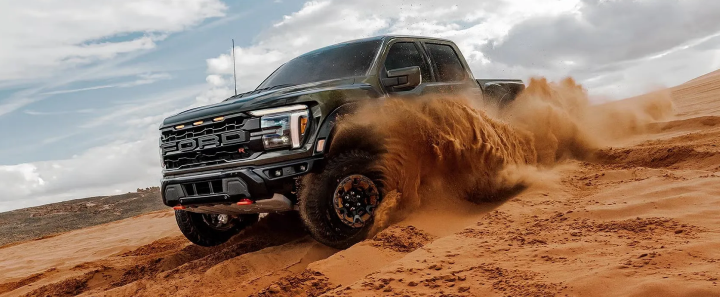
- Ford F-150: the full-size default when one truck has to do everything.
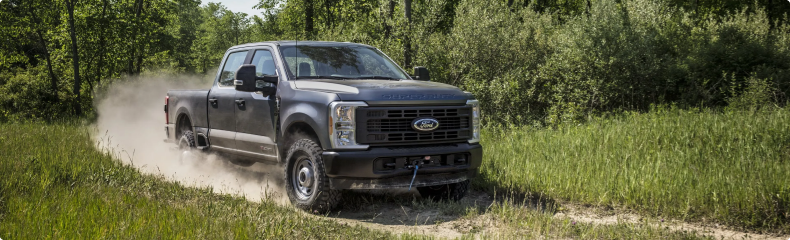
- Ford Super Duty: the answer when the trailer hooks to a hitch in the bed instead of the bumper.
If one of those lines already describes your week, skip ahead to that truck. If two of them do, the tables below are where it gets decided.
What This Guide Covers
What This Guide Covers
In this order: how to choose a Ford truck, the four trucks at a glance, the individual truck breakdowns, towing and payload compared honestly, what each one costs to get into, why the configuration decides the rating, trucks in Central Indiana, how to find one on our lot, and the questions we get asked most.
How to Choose a Ford Truck
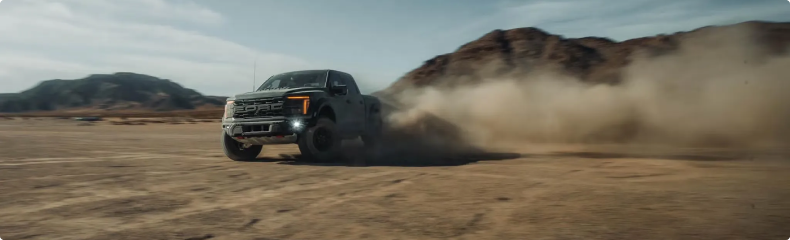
How to Choose a Ford Truck
Four questions sort these trucks faster than any spec sheet. Answer them honestly and the list usually shrinks to one or two.
What do you tow, and how does it hitch? That is the first question of the four, and it matters more than the pounds do. A trailer that hooks behind the bumper is called bumper-pull work. A trailer riding on a ball or a plate bolted into the bed itself, which is how a gooseneck hitch and a fifth wheel mount, is a different conversation, because the heaviest ratings on this page belong only to that second kind. Bumper-pull work is where the Maverick, the Ranger and the F-150 carry their ratings, and across those three the ceilings run up to 4,000 lb, up to 7,500 lb and up to 13,500 lb when each is properly configured. The moment the hitch moves into the bed, the shortlist is one truck long: among these four Ford pickups, only the Super Duty carries a rating for that kind of load.
What do you carry? Payload is more than what goes in the box, the bed behind the cab. It counts passengers, the toolbox, the bed topper, the fuel in the tank of whatever machine you are hauling, and the downward weight the trailer itself puts on the truck through the hitch, called tongue weight on a bumper hitch and pin weight on a bed hitch. That last one trips people up: a buyer who cleared the tow rating on paper can still go over the payload number printed on the sticker in the door jamb. Across these four the payload maximums run up to 1,500 lb, 1,767 lb, 2,175 lb and 8,000 lb on properly configured trucks, and the size of that last jump is what separates the Super Duty from the three light-duty trucks here.
How much truck can you live with on the days you are not towing? A truck that clears the trailer but will not fit your garage, your parking deck or your patience in traffic is the wrong truck. Cab and box size are the two levers, and on this page they cover a lot of ground: the boxes run from the Maverick's 33.3 cu ft up to the Super Duty's 78.5 cu ft eight-foot bed, and the cabs from a three-seat Regular Cab to a six-seat Crew Cab. Every foot of that has to fit the driveway, the jobsite turnaround and the parking space you use daily, not just the load you bought the truck for.
What will fuel cost you? The EPA-estimated combined figures on this page come from the Environmental Protection Agency, the federal body that runs the fuel-economy tests. In miles per gallon they run from 38 for a front-wheel-drive Maverick hybrid down to 17 for a Ranger Raptor, and the Super Duty carries no EPA rating at all. Over a long weekly commute that spread is real money. If most of your weeks are an empty bed sitting in traffic, the EPA figure matters more to your budget than the tow rating ever will.
Put those four answers together and the shortlist tends to write itself.
| If this is your week | Start with | The numbers behind it |
|---|---|---|
| Commuting and errands most days, occasional hauling, any trailer under 4,000 lb | Maverick | EPA-estimated 38 combined for the front-wheel-drive hybrid, up to 4,000 lb of towing with the 4K Tow Package on all-wheel drive, 33.3 cu ft box |
| A four-wheel-drive frame truck for trails, two-track trails and midsize work that still parks like a normal vehicle | Ranger | Up to 7,500 lb towing and up to 1,767 lb of payload, properly configured, with a 4.97 ft box holding 43.5 cu ft |
| One truck covering the family, the job and a bumper-pull trailer, with room to configure it your way | F-150 | Up to 13,500 lb towing and up to 2,175 lb of payload, each on its own four-wheel-drive build, with three cabs, three boxes and six engines |
| A gooseneck or fifth-wheel trailer, meaning the hitch sits in the bed, or weight beyond what a light-duty payload rating allows | Super Duty | Up to 40,000 lb towing on a gooseneck or fifth-wheel hitch and up to 8,000 lb of payload, properly configured |
The Four Ford Trucks at a Glance
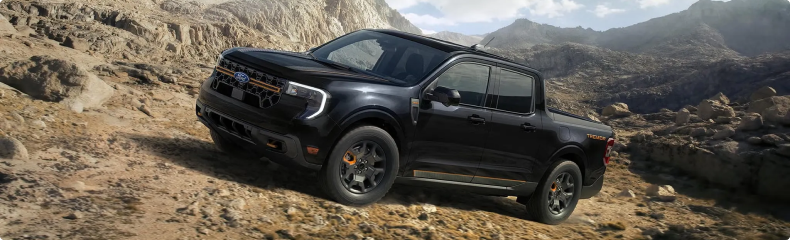
The Four Ford Trucks at a Glance
Here are the four side by side. Every capability figure is an up-to maximum on a properly configured truck, and where a cell carries a note, that note names the configuration or the exception behind the figure.
| Truck | Size class and body | Seats | Max tow, properly configured | Max payload, properly configured | EPA-estimated combined mpg, best configuration | Best for |
|---|---|---|---|---|---|---|
| Maverick | Compact unibody pickup, SuperCrew only | 5 | Up to 4,000 lb with the 4K Tow Package on all-wheel drive (2,000 lb without it) | Up to 1,500 lb (2.0L front-wheel or all-wheel drive, and the hybrid front-wheel drive) | 38 (hybrid front-wheel drive) | Commuting first, hauling on the weekend |
| Ranger | Midsize body-on-frame pickup, SuperCrew only | 5 | Up to 7,500 lb (the Ranger Raptor's own maximum is 5,510 lb) | Up to 1,767 lb | 23 (2.3L rear-wheel drive) | Trails, two-track trails and midsize work |
| F-150 | Full-size light-duty pickup, Regular Cab, SuperCab or SuperCrew | 3 in Regular Cab, 5 to 6 in SuperCab and SuperCrew | Up to 13,500 lb (3.5L EcoBoost, four-wheel drive) | Up to 2,175 lb (3.5L EcoBoost, four-wheel drive, a separate build from the tow maximum) | 23 (3.5L PowerBoost hybrid, four-wheel drive) | One truck covering family, work and a trailer |
| Super Duty | Heavy-duty pickup on the F-250, F-350 or F-450 chassis | 3 in Regular Cab, 6 in SuperCab and Crew Cab | Up to 40,000 lb, gooseneck or fifth-wheel only | Up to 8,000 lb | Not EPA-rated (over 8,500 lb GVWR) | Gooseneck and fifth-wheel loads |
One note on the fuel-economy column. Super Duty pickups are built above 8,500 pounds gross vehicle weight rating (GVWR), which puts them past the cutoff for federal light-duty fuel-economy testing, so the EPA does not rate one and no official combined figure exists. That is a rulebook line about weight class, not a comment on how thirsty the truck is.
Ford Maverick
Ford Maverick
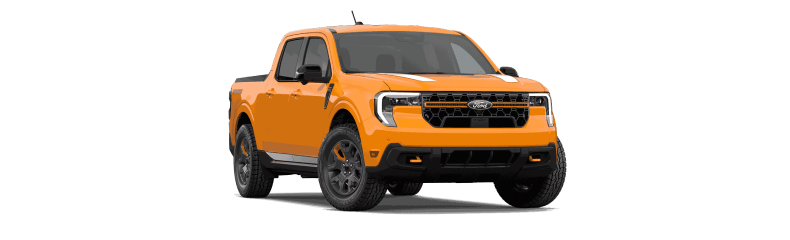
Of Ford's four pickups the Maverick is the only unibody one, built on a car-style structure instead of a separate frame, and every one is a SuperCrew seating five with an open 33.3 cu ft box behind the cab. Two engine choices: a 2.0L EcoBoost making 250 hp and 280 lb-ft, or a 2.5L hybrid making 184 hp of combined output. The front-wheel-drive hybrid is EPA-estimated at 42 mpg city, 35 highway and 38 combined. Properly configured it tows up to 4,000 lb with the 4K Tow Package on all-wheel drive, and payload reaches up to 1,500 lb. The swap is plain: it drives, parks and refuels like a small crossover, and it hauls like a compact truck instead of a full-size one.
Choose this if: most of your miles are commuting and errands, and the hauling is mulch, bikes, a dump run and a small trailer now and then.
Look elsewhere if: you tow above 4,000 lb even occasionally, or you need a bed long enough for full sheets of plywood lying flat.
The full picture is on our 2026 Ford Maverick page.
Ford Ranger
Ford Ranger
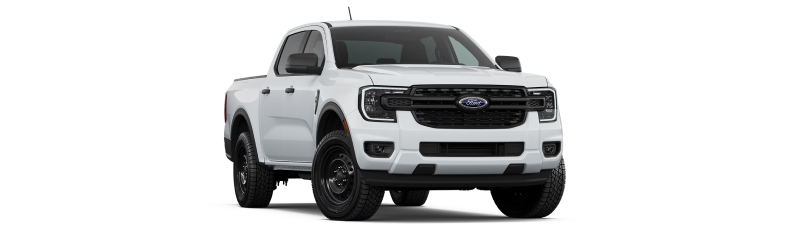
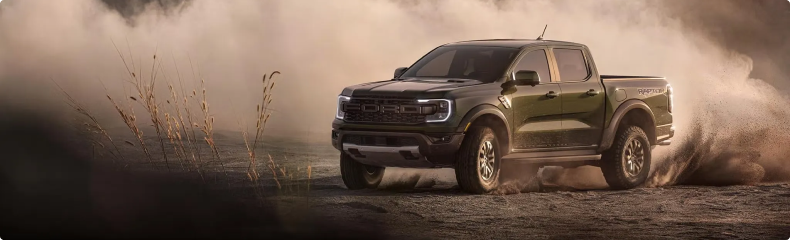
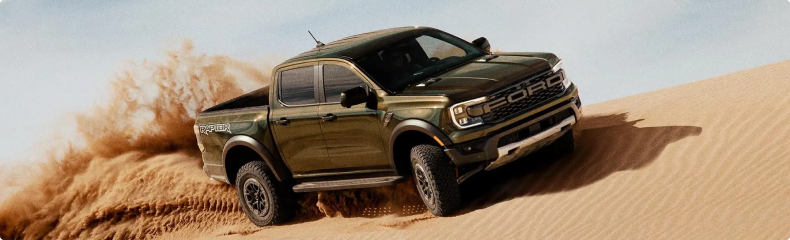
The Ranger is a body-on-frame midsize truck, SuperCrew only, seating five, with a 4.97 ft box holding 43.5 cu ft. Three engines are offered: a 2.3L EcoBoost at 270 hp and 310 lb-ft, a 2.7L EcoBoost V6 at 315 hp and 400 lb-ft, and in the Ranger Raptor a 3.0L EcoBoost V6 at 405 hp and 430 lb-ft. Properly configured it pulls up to 7,500 lb, payload tops out at 1,767 lb, and EPA-estimated combined figures run 23 mpg for the rear-wheel-drive 2.3L, 21 for the four-wheel-drive 2.3L, 20 for the 2.7L and 17 for the Raptor. Here is what you are swapping: you get genuine frame and four-wheel-drive truck hardware in a footprint that still fits an ordinary garage, and you give up the bed length and the heavier ratings the full-size trucks carry.
Choose this if: you want a frame truck for trails, two-track trails and midsize work without living with full-size bulk every day.
Look elsewhere if: you regularly tow above 7,500 lb, or you need one of the longer boxes that only the full-size and heavy-duty trucks here offer.
Go deeper on our Ford Ranger overview.
Ford F-150
Ford F-150
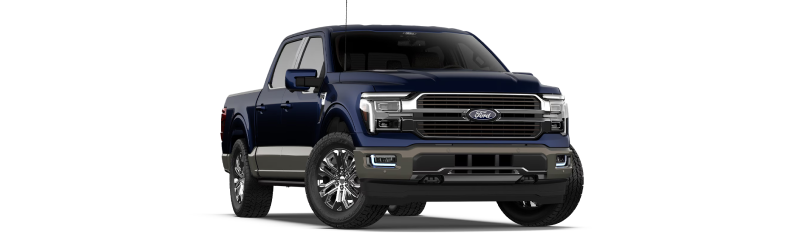
The F-150 is the full-size default and the most configurable truck of these four, which is exactly why it takes more thought than the other three. Regular Cab seats three, SuperCab and SuperCrew seat five to six, and the three boxes hold 52.8, 62.3 and 77.4 cu ft.
Six engines are offered. The 2.7L EcoBoost makes 325 hp and 400 lb-ft, the 5.0L V8 makes 400 hp and 410 lb-ft, and the 3.5L EcoBoost makes 400 hp and 500 lb-ft. The 3.5L PowerBoost full hybrid makes 430 hp and 570 lb-ft. At the top sit the F-150 Raptor's High-Output 3.5L EcoBoost at 450 hp and 510 lb-ft and the Raptor R's supercharged 5.2L V8 at 720 hp and 640 lb-ft.
Every F-150 capability figure here is a four-wheel-drive one: towing reaches up to 13,500 lb and payload up to 2,175 lb, each on its own properly configured build. The PowerBoost hybrid carries EPA estimates of 22 mpg city, 24 highway and 23 combined.
Choose this if: one truck has to cover the family, the job and a trailer, and you want the widest set of cab, box and engine combinations of any Ford pickup.
Look elsewhere if: your trailer hitches in the bed rather than at the bumper, or your week is mostly an empty truck in traffic.
The configuration detail lives on our 2026 Ford F-150 page.
Ford Super Duty
Ford Super Duty
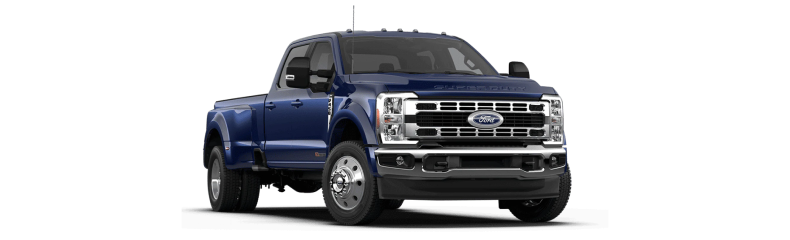
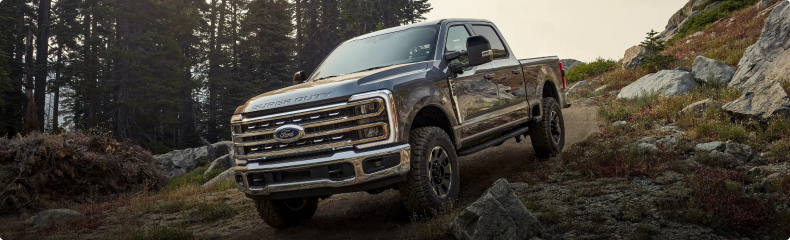
The Super Duty is the heavy-duty end of the lineup, built on the F-250, F-350 and F-450 chassis, offered with two-wheel drive (4x2) or four-wheel drive (4x4) and never as all-wheel drive, with a 10-speed automatic behind every engine. There are four of those: a 6.8L V8 gas at 405 hp and 445 lb-ft, a 7.3L V8 gas at 430 hp and 485 lb-ft, a 6.7L Power Stroke diesel at 475 hp and 1,050 lb-ft, and the High-Output 6.7L Power Stroke at 500 hp and 1,200 lb-ft. Properly configured it pulls a trailer of up to 40,000 lb from a hitch mounted in the bed, gooseneck or fifth-wheel, and carries up to 8,000 lb in the box. Regular Cab seats three, SuperCab and Crew Cab seat six, and the boxes measure 65.4 cu ft (6-3/4 ft) or 78.5 cu ft (8 ft). Nothing else on this page comes near it on a heavy trailer, and you pay for that in size, in price and in fuel you cannot look up before you buy.
Choose this if: you pull a gooseneck or fifth-wheel trailer, or you carry weight a light-duty truck's payload rating cannot legally take.
Look elsewhere if: the truck spends most of its life empty, in traffic, and parked in a normal driveway.
For the chassis-by-chassis detail, see our 2026 Ford Super Duty page.
Towing and Payload, Compared Honestly
Towing and Payload, Compared Honestly
Advertised maximums hide their fine print, so here it is. Read how each rating is achieved, not just the pounds. That is where most comparison shopping goes wrong.
| Truck | Max tow | How that rating is achieved | Max payload | Payload basis |
|---|---|---|---|---|
| Maverick | Up to 4,000 lb | The 4K Tow Package on an all-wheel-drive Maverick; without that package the rating is 2,000 lb | Up to 1,500 lb | The 2.0L with front-wheel or all-wheel drive, and the hybrid with front-wheel drive. The all-wheel-drive hybrid rates 1,400 lb, and the Tremor and Lobo versions of the Maverick rate 1,140 lb and 1,045 lb |
| Ranger | Up to 7,500 lb | The maximum available on a properly configured Ranger. The Ranger Raptor is not that truck: its own maximum is 5,510 lb | Up to 1,767 lb | Maximum available on a properly configured Ranger |
| F-150 | Up to 13,500 lb | The 3.5L EcoBoost V6. Every F-150 tow figure here is a four-wheel-drive rating: 2.7L EcoBoost 8,200 lb, 5.0L V8 12,800 lb, 3.5L EcoBoost 13,500 lb, PowerBoost hybrid 11,600 lb, Raptor 8,200 lb, Raptor R 8,700 lb | Up to 2,175 lb | Four-wheel drive throughout: 2.7L 1,715 lb, 5.0L V8 2,080 lb, 3.5L EcoBoost 2,175 lb, PowerBoost 1,740 lb, Raptor 1,405 lb, Raptor R 1,410 lb. The tow maximum and the payload maximum are two different builds and are never both true of one truck |
| Super Duty | Up to 40,000 lb, gooseneck or fifth-wheel only | A properly configured Super Duty with the trailer riding on a hitch mounted in the bed floor, over the rear axle. Conventional bumper-pull ratings are lower and move with the configuration | Up to 8,000 lb | Maximum available across the F-250, F-350 and F-450 chassis, properly configured |
Two things are worth saying out loud. First, the F-150's 13,500 lb and 2,175 lb are separate maximums on separate trucks, so no single build claims both. Second, the Super Duty's 40,000 lb is a gooseneck and fifth-wheel number only, which is why hitch type is the first of the four questions above and not the last.
What It Costs to Get Into Each Ford Truck
What It Costs to Get Into Each Ford Truck
Ford calls its trim levels grades. The table below lists the priced grades for each truck, lowest first. Every figure is a launch price, the manufacturer's suggested retail price (MSRP) for the current model year, and every one leaves out destination, the factory delivery charge added to every new truck.
| Truck | Grade | MSRP at launch, destination excluded |
|---|---|---|
| Maverick | XLT | $30,645 |
| Ranger | XL | $33,550 |
| Ranger | XLT | $36,075 |
| Ranger | Lariat | $43,955 |
| Ranger | Raptor | $57,270 |
| F-150 | XL | $39,330 |
| F-150 | XLT | $44,695 |
| F-150 | Lariat | $59,560 |
| F-150 | Platinum | $68,800 |
| F-150 | Raptor | $79,005 |
| Super Duty | F-250 XL | $45,975 |
| Super Duty | F-450 Limited | $96,335 |
Lined up by the lowest grade priced here, it reads $30,645 for a Maverick XLT, $33,550 for a Ranger XL, $39,330 for an F-150 XL and $45,975 for a Super Duty F-250 XL, all at launch and all before destination. Two rows deserve a word of their own. XLT is the Maverick grade priced here, so read $30,645 as the XLT figure and not as a floor for the whole model line. The Super Duty band stretches as far as it does because that one name spans three chassis, two fuel types and a grade range that runs from an F-250 XL Regular Cab to an F-450 Limited, so the two ends of one name really do sit that far apart.
Capability moves price too, and it moves it the same direction as the ratings. The packages, drivetrains and engines that unlock the higher tow and payload figures above are the same items that move a truck up its own price ladder, which is why the cheapest way into a model is rarely the build that hits its advertised maximum. What any one truck costs today comes down to how that particular truck was built, so the listings under new Ford trucks in stock show what each truck standing here now is actually priced at. Our Ford specials page shows which models have a deal running this month.
The Part Most Truck Guides Skip: The Configuration Decides the Rating
The Part Most Truck Guides Skip: The Configuration Decides the Rating
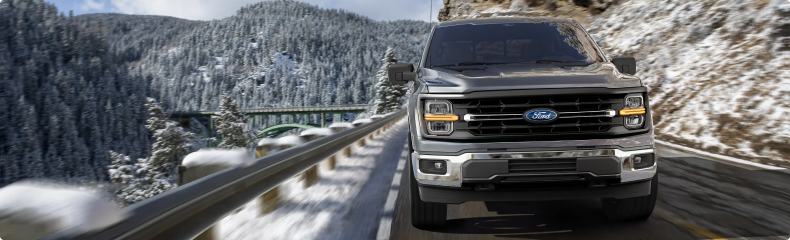
Every capability number on this page, and on every other truck page you will read, is a maximum for a properly configured vehicle. Cab, box length, drivetrain, engine, rear axle ratio and whether the truck left the factory with a tow package all move the figure, sometimes by thousands of pounds. Of the four trucks here, the Maverick shows it most plainly: 4,000 lb when the 4K Tow Package is fitted to an all-wheel-drive truck, 2,000 lb without it, same name on the tailgate. The F-150 shows it across engines instead, where four-wheel-drive tow ratings run from 8,200 lb up to 13,500 lb and payload from 1,405 lb up to 2,175 lb, depending entirely on what is under the hood.
It is also why two trucks that look identical in a parking lot can be rated hundreds or thousands of pounds apart, and why the build details settle arguments a model name cannot. If you are weighing a truck here against one somewhere else, compare the configurations and not the brochures. Drivetrain, engine, axle ratio and tow package are the items that decide whether the advertised maximum is actually yours.
Engines are one of those levers, and the four trucks give you very different amounts of choice:
| Truck | How many engines | Headline output |
|---|---|---|
| Maverick | 2 | 250 hp and 280 lb-ft from the 2.0L EcoBoost; 184 hp combined from the 2.5L hybrid |
| Ranger | 3 | Up to 405 hp and 430 lb-ft from the Raptor's 3.0L EcoBoost V6 |
| F-150 | 6 | Up to 720 hp and 640 lb-ft from the Raptor R's supercharged 5.2L V8 |
| Super Duty | 4 | Up to 500 hp and 1,200 lb-ft from the High-Output 6.7L Power Stroke diesel |
Between cabs, boxes, drivetrains and engines the possible combinations run further than any lot can hold, which means the truck you need may not be one standing in front of you today. If your trailer, your payload and your cab requirement point at a combination nobody stocks, you do not have to give up the requirement that matters most. Have it built to your specification at the factory and wait for the right truck instead of settling for the close one.
Trucks in Central Indiana

Trucks in Central Indiana
Around Anderson a pickup is a tool, not an accessory, and the job mix shows it. Advanced manufacturing, logistics and warehousing, driveshaft production and food production all keep working pickups moving on weekdays, and healthcare adds a steady base of commuters on top of that.
That mix puts two different buyers on the same lot. One arrives with a load to move and reads the payload column before anything else. The other is doing the math on five round trips a week and goes straight to the fuel-economy column. Drive out of town in any direction and the rural townships turn to corn and soybean ground, where a truck is equipment instead of transport, and where payload matters more than horsepower on most days of the year.
The smaller towns across Madison County also carry a heavy manufactured-housing presence, and those towns hold a real gooseneck and fifth-wheel audience, not a hypothetical one. Those buyers are shopping Super Duty from the first question, because a bumper-pull rating was never the relevant number for them, and the Super Duty's up to 40,000 lb rating on a properly configured truck applies only to a gooseneck or fifth-wheel hitch. Meanwhile the interstate run south into Indianapolis means plenty of truck shoppers here put highway miles on a pickup five days a week before they ever hook to anything, which is where the Maverick hybrid at an EPA-estimated 38 combined and the F-150 PowerBoost at 23 earn their place in this lineup.
Winter is the ordinary Indiana kind: wet, cold and slick often enough that four-wheel drive lands on most shoppers' lists for reasons that have nothing to do with towing. Drivetrain is not only a winter decision either, because it also changes what these trucks are rated to pull. The F-150 ratings quoted throughout this guide are four-wheel-drive figures and the Maverick's 4,000 lb rating is an all-wheel-drive one, so the winter decision and the towing decision usually arrive together instead of separately. Madison County has one Ford store to walk into, and a shopper who arrives with the wrong truck in mind has nowhere else in the county to correct it, so we keep all four of these trucks in the conversation instead of pointing everyone at the same one. That is why we open with what you are pulling rather than which is the biggest truck on the lot.
Find Your Ford Truck at Ed Martin Ford
Find Your Ford Truck at Ed Martin Ford
All four of these trucks come through our Anderson lot, and what is in stock shifts week to week. Of the ways to narrow this down, standing next to the real configurations settles it quickest. Browse our new Ford inventory to see which cabs, boxes and engines are here right now, and check our current Ford offers for what is running this month. If the exact configuration you need is not sitting on the lot, we can order it from the factory built the way you want it. When you are ready to talk it through, get in touch with our team and bring your trailer numbers with you.
Frequently Asked Questions About Ford Trucks
These come up most often when a buyer is deciding between the four.
Which Ford truck tows the most?
The Super Duty, at up to 40,000 lb when properly configured, and only when the trailer rides on a gooseneck ball or a fifth-wheel plate in the bed. Among the light-duty trucks in this lineup, the F-150 leads at up to 13,500 lb with the 3.5L EcoBoost and four-wheel drive. There is more on the 2026 Ford Super Duty and 2026 Ford F-150 pages.
Which Ford truck is best for a daily commute?
The Maverick, and it is not close among these four. EPA estimates for the front-wheel-drive hybrid are 42 mpg city, 35 highway and 38 combined, it is the only unibody truck of the four, and it still gives you a 33.3 cu ft open box for weekend work. Full details are on our 2026 Ford Maverick page.
Do I need a Super Duty, or will an F-150 do?
Start with how your trailer hitches. If it mounts to a ball or a plate in the bed floor, you are shopping Super Duty, because that is the only truck of these four rated for that kind of load, at up to 40,000 lb properly configured. If your trailer hooks behind the bumper and stays under the F-150's four-wheel-drive maximum of 13,500 lb, the F-150 does the job with a lot less truck around it.
Which Ford truck is cheapest to get into?
The Maverick. Its XLT launched at $30,645, excluding destination, which is the lowest launch price of Ford's four pickups. The Ranger XL launched at $33,550, the F-150 XL at $39,330 and the Super Duty at $45,975 for an F-250 XL.
Which Ford truck gets the best mileage?
The Maverick hybrid, at an EPA-estimated 38 mpg combined with front-wheel drive, has the highest combined figure among the four trucks in this guide. The all-wheel-drive Maverick hybrid is rated 37 combined, the Maverick's 2.0L is 26 with front-wheel drive and 25 with all-wheel drive, and the F-150 PowerBoost hybrid reaches 23 combined with four-wheel drive.
What is a gooseneck hitch, and how is it different from a fifth wheel?
Both are hitches that mount in the bed of the truck rather than behind the bumper, so the trailer's weight sits over the rear axle instead of hanging off the back. A gooseneck uses a ball in the bed floor and is common on equipment and livestock trailers; a fifth wheel uses a plate like the one on a semi tractor and is common under large travel trailers. Ford's 40,000 lb Super Duty rating applies to these two hitch types only.
Why is there no fuel-economy figure for the Super Duty?
Because of its weight class. The Super Duty is built above 8,500 pounds gross vehicle weight rating, which is the cutoff for federal light-duty fuel-economy testing, so the EPA does not rate it and there is no official combined number to quote. Every other truck on this page is rated normally.
How many people can each of these Ford trucks seat?
The Maverick and the Ranger seat five, since both come only as a SuperCrew. The F-150 seats three as a Regular Cab and five to six as a SuperCab or SuperCrew. The Super Duty seats three as a Regular Cab and six as a SuperCab or Crew Cab.
Does the Maverick really tow 4,000 pounds?
Yes, but only in one configuration: all-wheel drive with the factory 4K Tow Package. Without that package the rating is 2,000 lb, so if towing is part of why you are buying, do not skip that package. Check the equipment on any specific truck among the new Fords on our lot.
Can I order a truck instead of buying one off the lot?
Yes. If the cab, box, drivetrain and engine combination you need is not in stock, we can place a factory order and have it built to that specification. It is the sensible route when a capability rating depends on a specific package, because the ordered truck arrives with the equipment the rating requires.
Which of these trucks has the biggest bed?
The Super Duty, with an 8 ft box holding 78.5 cu ft, has the largest bed of the four trucks compared here. The F-150's boxes hold 52.8, 62.3 and 77.4 cu ft, the Ranger's 4.97 ft box holds 43.5 cu ft, and the Maverick's open box holds 33.3 cu ft.